Quantity is not enough: Why the seafarer shortage is also a competence gap

The world fleet is short of 39,100 STCW-certified officers this year, yet it has a surplus of 56,890 ratings. Shipping does not simply lack people. It lacks experienced officers, and that makes the shortage a safety question as much as a recruitment one, notes Pavel Manchenko, Founder and Managing Director, Marine MAN.
Quantity: The gap keeps widening
According to the BIMCO/ICS Seafarer Workforce Report 2026, around 2.57 million seafarers serve 85,148 merchant ships. The headline number looks healthy. The detail does not.
The officer shortage has grown with every edition of the report: 16,500 in 2015, 26,240 in 2021 and 39,100 in 2026. Over the last five years, demand for officers rose by 23.1%, while supply grew by 22%. By 2030, the industry will need another 113,735 officers, or roughly 22,747 new officers every year.
Ratings are in surplus, so the bottleneck sits at the officer level. That is exactly where experience matters most for safe operations.
Quality: When promotion outpaces experience
When demand for officers grows faster than supply, the gap is usually closed in one way: people are promoted sooner. A second officer becomes chief officer after fewer contracts. A third engineer steps up before seeing enough real failures at sea. Every certificate is valid, but the experience behind it is thinner.
This matters because the human element is still the main factor in casualties. Allianz has estimated that 75% to 96% of shipping accidents involve human error. Most of these are not gaps in knowledge on paper. They are judgement calls: when to reduce speed, when to call the master, when to stop a job.
A certificate proves that an officer has passed training. It does not prove that they have handled a heavy-weather passage, a blackout in a narrow channel or a shifting cargo. That knowledge comes from time on board and from the people standing next to you.
Direct hiring is also a quality decision
Quality is lost not only at sea but also in the hiring chain. A vacancy often passes from shipowner to manager, to agency, to sub-agent. Each step filters information. The shipowner sees a CV and a list of certificates. The seafarer sees a rank, a salary and a joining date.
Direct contact between shipowner and seafarer shortens that chain. The employer can check real sea service on similar vessel types and talk to the candidate before deciding. The seafarer can learn about the vessel, the company and the crew before signing. Better information on both sides tends to mean better matches, longer service with one company and higher retention.
Direct hiring does not replace professional crew management services. It changes their focus. The value of a crew manager moves from forwarding CVs to verification, competence checks, compliance and support for the crew on board.
Mentorship: Passing on what cannot be certified
The most direct way to close the experience gap is to connect people who have experience with those who need it. Every year senior officers retire or move ashore, and much of what they know leaves with them. Mentorship keeps that knowledge in the industry.
On our platform we run a seafarer mentorship programme with a simple model. Experienced officers and engineers apply as mentors, and we verify and approve them. Junior seafarers choose a mentor and agree the terms directly. Mentors set their own rates, and the platform takes no part in the payment.
The topics are practical: preparing for promotion, a first contract on a new vessel type, an oral exam or a difficult situation on board. For young people who are just starting to look for sea jobs, a mentor answers questions that a training centre or an agency rarely covers.
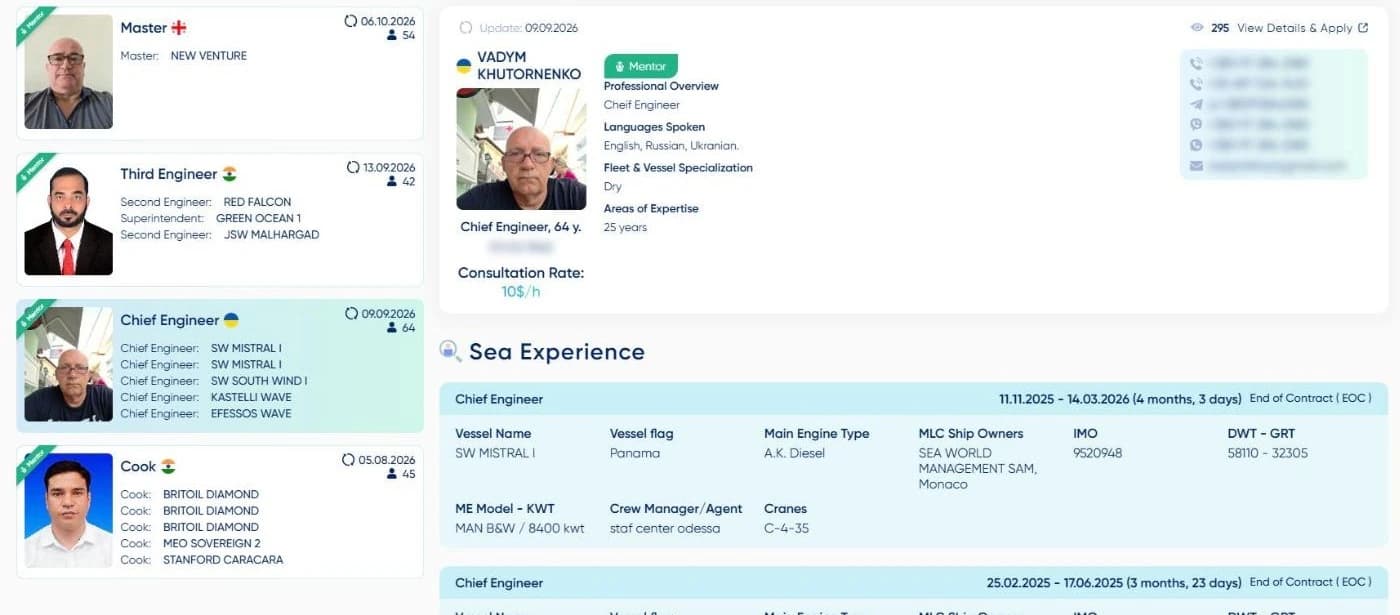
Mentorship does not replace STCW training or supervision on board. It adds what neither can fully deliver: the personal experience of someone who has already been there.
Quantity and quality together
The BIMCO/ICS figures tell us how many officers we need. They do not tell us how ready those officers will be. Recruiting 22,747 new officers a year is a task for the whole industry.
Making sure each of them is ready for their rank is a task for every shipowner, manager and senior seafarer.
Three steps help, and none of them needs new regulation:
- Shorter, more transparent hiring chains between shipowners and seafarers
- Verification of real sea service, not only of paperwork
- Structured knowledge transfer from senior to junior crew
Marine MAN runs jobmarineman.com, a direct crew hiring platform for shipowners and seafarers. Shipowners and managers can contact at b2b@marineman.eu
The views presented hereabove are only those of the author and do not necessarily reflect those and are for information sharing and discussion purposes only.