Amendments to the IGC Code to enter into force in July 2028

Major amendments to the International Code for the Construction and Equipment of Ships Carrying Liquefied Gases in Bulk (IGC Code) are set to take effect on 1 July 2028.
Since 2022, the International Maritime Organization (IMO), through its Sub-Committee on Carriage of Cargoes and Containers (CCC), has been undertaking a comprehensive revision of the International Code for the Construction and Equipment of Ships Carrying Liquefied Gases in Bulk (IGC Code).
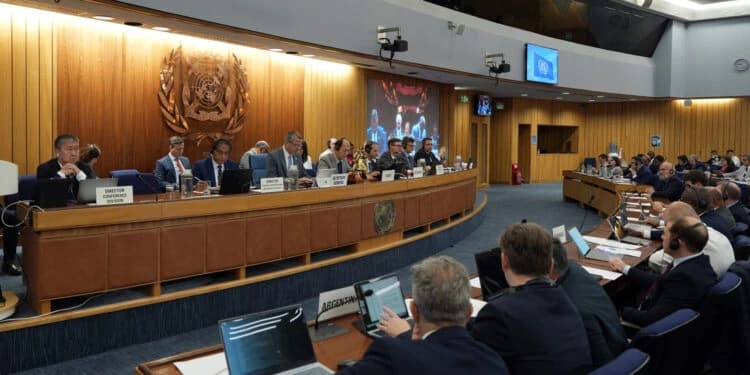
The review reflects the maritime industry’s growing adoption of environmentally friendly technologies and increasing pressure to reduce greenhouse gas emissions. The resulting amendments were approved at the 111th session of the IMO’s Marine Safety Committee (MSC 111) in May 2026 and are expected entry into force on 1 July 2028.
Once adopted, the amendments will introduce updated requirements for the construction and equipment of ships transporting liquefied gases in bulk.
The amendments cover a variety of issues, including:
- Clarification of the application of the “one ship, one code” discussion in relation to the use of alternative fuels on board gas carriers under the provisions of the IGC Code.
- Application of finite element analysis to type C tanks.
- Carriage of CO₂ cargoes and the use of LPG, ethane and toxic cargoes as fuel. Enhancement and clarification of Causes and Effects Matrix of an ESD (Emergency Shut Down).
- Cargo tank filling limits.
Applicability of amendments
The IGC Code amendments apply to existing and new ships as appropriate. However, if an amendment requires changes in a ship’s design or construction, that amendment will only be applicable to ships constructed on or after 1 July 2028.
Consequently, a three-date application system has been agreed that defines “new ships” as those for which:
- The building contract is placed on or after 1 July 2028; or
- In the absence of a building contract, the keels are laid or which are at a similar stage of construction on or after 1 January 2029; or
- The delivery of which is on or after 1 July 2032.
Certificate of Fitness
To reflect this three-date application system, revisions have also been approved for the form of the International Certificate of Fitness for the Carriage of Liquefied Gases in Bulk of the IGC Code.
MSC 111 confirmed that only products listed in Chapter 19 of the IGC Code should be included in the ship’s International Certificate of Fitness for the Carriage of Liquefied Gases in Bulk and identified as cargo and/or fuel, as appropriate in the revised table of the Certificate of Fitness.
Unified interpretations
When the approved IGC Code amendments come into force, the following IMO unified interpretations will no longer apply to new ships constructed on or after 1 July 2028:
- MSC.1/Circ.1543
- MSC.1/Circ.1559
- MSC.1/Circ.1590
- MSC.1/Circ.1606
- MSC.1/Circ.1617
- MSC.1/Circ.1625
- MSC.1/Circ.1651
- MSC.1/Circ.1669
- MSC.1/Circ.1679
The above will remain in effect for existing ships constructed prior to 1 July 2028.