A new scientific review argues that maritime accidents are too often explained by human error alone, even when the conditions behind those mistakes remain unexamined. The authors say prevention should focus on the organisational, operational and technological factors that shape performance, rather than treating the seafarer as the sole source of failure.
Review examines how errors emerge from broader safety conditions
The study, titled ”Human factors in maritime safety: An integrative narrative review of cognitive, behavioural and organisational determinants”, was written by Panagiotis Nikiteas and George Boustras of the European University of Cyprus. It draws on 20 core maritime research sources, alongside additional theoretical and cross-industry literature, to examine how human performance is influenced by work organisation, technology, environmental conditions, leadership and organisational culture.
At the centre of the review is a simple but important claim: human error should not automatically be treated as the root cause of an accident. In many cases, it may be the final visible result of multiple interacting conditions, several of which originate outside the individual mariner’s control. The authors say this distinction matters for accident investigation, safety management systems and the design of preventive measures.
Fatigue reflects scheduling, workload and recovery limits
Fatigue stands out in the literature as one of the most consistently reported maritime human-factor concerns. The review says it cannot be understood, or managed, only through reminders about alertness, training or compliance with rest-hour rules. Crew scheduling, limited recovery time, noise exposure, circadian disruption, staffing arrangements and commercial pressure can all increase fatigue-related risk.
The authors also point to a possible blind spot in accident investigations. In one study they reviewed, fatigue was formally identified in only 5.6% of the marine casualty reports analysed. The figure does not show how many accidents actually involved fatigue, but it does suggest that existing reporting practices may fail to capture the conditions that affect human performance.
In practical terms, the review says effective fatigue management depends on how work is organised, not just on whether paper requirements for rest hours have been met.
Communication failures are not only about language
Communication problems in shipping are often linked to multinational crews, but the review says the issue is broader than language proficiency. Hierarchy, cultural expectations, command structures and the willingness of junior crew members to challenge a decision can all shape whether important information is shared at the right moment.
A crew member may fully understand an order and still hesitate to question it, even when the instruction appears unsafe. For that reason, the researchers emphasise closed-loop communication, clear operational responsibilities and a working environment in which concerns can be voiced without fear of negative consequences. Their view is that communication competence should include team coordination, leadership behaviour, effective challenge procedures and psychological safety, not language training alone.
Safety culture shapes whether risks are seen and reported
The review treats organisational culture as a major factor in whether hazards are recognised, reported and acted on. Near misses, unsafe conditions and operational difficulties can all offer valuable warning signs, but only if personnel are willing to report them and management responds constructively. Punitive reporting systems, weak feedback and commercial pressure can all discourage disclosure.
As a result, the absence of reported problems does not necessarily mean that risks are absent. The authors argue that safety management systems need to move beyond recording incidents and corrective actions and start examining the organisational conditions that allow issues to develop, remain hidden or recur. In their view, an SMS is only as effective as the quality of reporting, organisational learning, leadership accountability and preventive follow-up that surround it.
Human error is often the product of interacting system pressures
One of the review’s main conclusions is that maritime accidents rarely arise from a single isolated cause. Instead, several conditions may operate together. Fatigue can reduce situational awareness, communication barriers can stop concerns from being raised, organisational pressure can encourage unsafe workarounds, and poorly designed interfaces or excessive alarms can increase cognitive load.
The authors also discuss the effects of digitalisation and automation. They say these technologies do not remove human-related hazards; instead, they can shift risk toward system supervision, exception handling, human-machine interaction and coordination between shipboard and shore-based operations. That shift may create new competence and decision-making demands, especially when automated systems fail or require unplanned human intervention.
The practical message is that accident prevention has to consider how people, technology, work processes and organisational choices interact. The review warns against treating individual mistakes as if they occur independently of the system around them.
From after-the-fact blame to preventive diagnosis
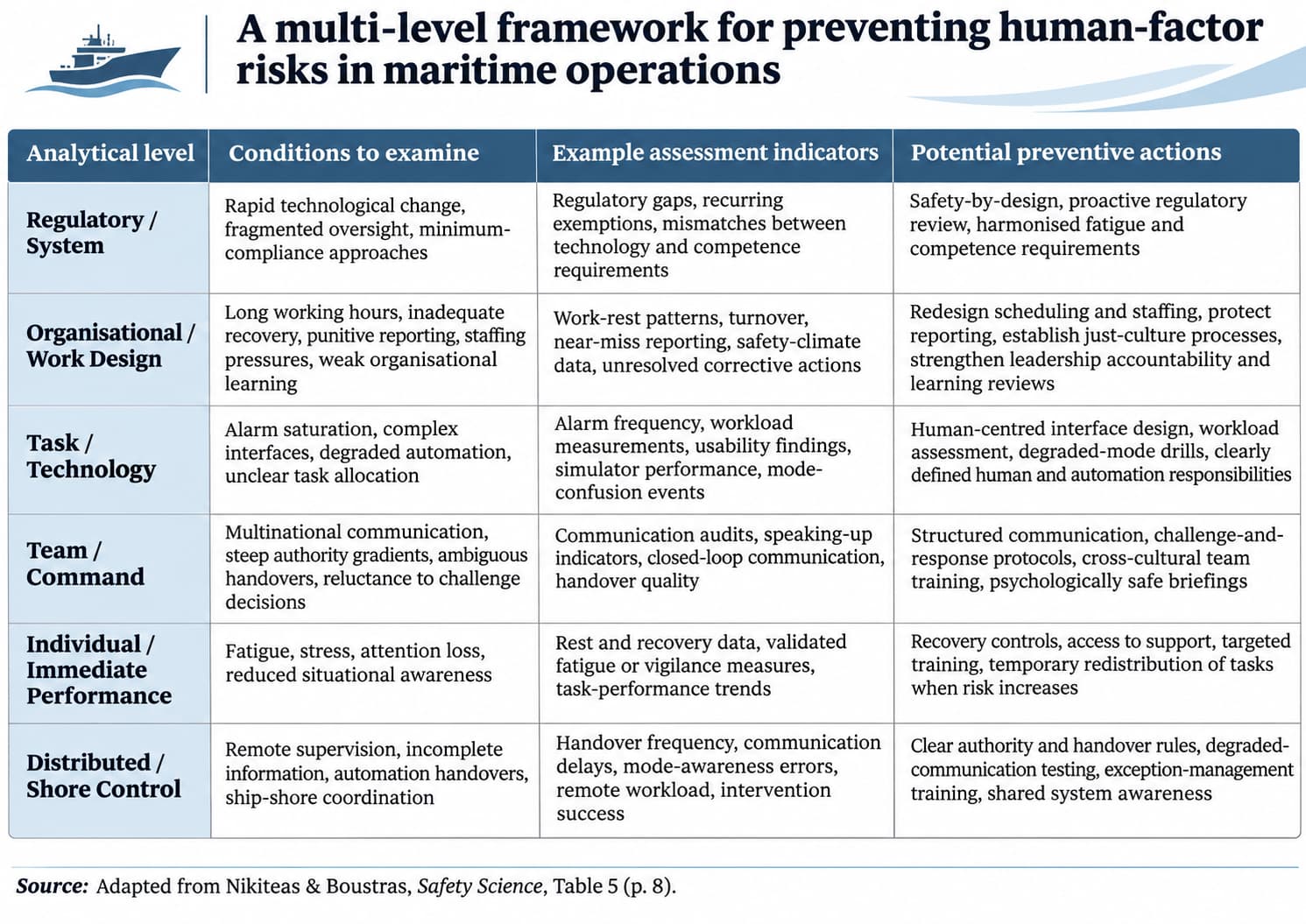
Beyond its critique of traditional accident analysis, the study proposes a preventive diagnostic framework that connects levels of the maritime safety system with observable risk conditions, assessment indicators and possible preventive actions. The aim is to help organisations identify the conditions that make errors more likely before those conditions contribute to an incident.
The authors note that the framework is a conceptual tool built from the literature, not a validated assessment instrument. They say its effectiveness and predictive value still need to be tested in operational maritime settings. Even so, they present it as a useful starting point for companies that want a broader approach to human-factor risk management.
What the framework offers is a way to look for warning signs earlier, rather than waiting for an accident to reveal them. That emphasis on diagnosis before failure is one of the review’s central contributions to prevention thinking.
What maritime safety management should change
The findings draw a line between correcting a mistake and preventing the conditions that make a mistake likely. Traditional corrective responses often rely on more training, revised procedures, closer supervision or reminders to be careful. The authors do not dismiss those measures, but they say they may be inadequate when the deeper problem involves work design, operational pressure, organisational culture or technology.
They give several examples. Additional fatigue-awareness training will not resolve risks caused by insufficient recovery opportunity. Communication training will have limited effect if crew members are afraid to challenge authority. Automation training cannot fully make up for confusing interfaces or unclear responsibilities.
This does not remove personal accountability or reduce the importance of professional competence. Instead, the review argues that safe performance depends both on the individual and on the environment in which that individual works. The study also notes a current research gap: although recurring human-factor conditions are well documented, there is still a need for stronger evidence on which organisational and preventive interventions work best.
That leaves maritime safety management with a difficult task: moving beyond identifying contributing factors and toward measuring whether preventive action actually improves operational performance. The broader lesson is that effective prevention must address the system, not only the person.
The wider implication for shipping
The value of the review lies less in introducing entirely new human-factor risks than in assembling existing evidence into a prevention-focused framework. Its relevance increases as shipping becomes more digitalised and operational decisions depend on more complex interactions between seafarers, shore-based staff and automated systems.
For maritime organisations, the key questions should therefore extend beyond who made the mistake or which procedure was not followed. They should also ask why the mistake was possible, what organisational or technical conditions helped create it and what changes could reduce the chance of recurrence.
Ultimately, the study argues that safer shipping requires more than better individual performance. It requires conditions that make safe performance the natural result of how work is designed, managed and carried out. The challenge, the authors suggest, is whether maritime safety systems are focused enough on preventing the conditions behind human error, or whether they still mainly exist to identify, document and correct mistakes after they have already happened.