A crew member suffered a finger injury while trying to hold back a rotating belt during maintenance on an Air Handling Unit, underscoring the danger of residual mechanical energy even when electrical power has already been isolated. The incident was highlighted by the International Marine Contractors Association in Safety Flash SF 20/26, published on 18 November 2026, as a reminder that equipment must be confirmed safe before work starts.
What happened
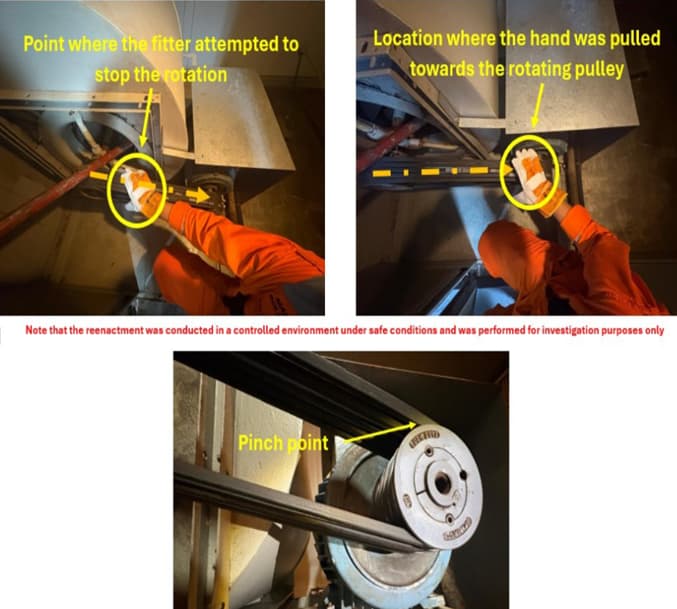
IMCA said the event took place while a crew member was repairing a broken grease nipple on an Air Handling Unit (AHU). The electrical supply had been isolated, but the unit’s V-belt was still moving because energy remained stored in the system. During the task, the worker tried to restrain the belt by hand, and two fingers were drawn into the pinch point between the belt and pulley.
The injury resulted in a laceration and a hairline fracture to a fingertip. After medical assessment, it was recorded as a Restricted Work Case (RWC). IMCA also classified it as High Potential (HIPO), saying the outcome could have been much more severe, including the possible loss of one or more fingers.
The flash does not say more about the work setup, how long the maintenance lasted or whether anyone else was present. Even so, the sequence of events shows a clear hazard: switching off electrical power does not automatically remove the mechanical energy that can keep equipment moving.
What went wrong
The immediate hazard came from contact with a rotating part that had not been verified as safe. Although the electrical isolation had been completed, the belt still had the capacity to move. By placing his hand on the belt, the worker put his fingers directly into the hazardous zone between two moving components.
IMCA said residual mechanical energy must be identified, checked and controlled by an authorised and competent person before maintenance begins. The association also questioned whether broad risk assessments are enough for rotating machinery tasks, because a general review may note moving parts without dealing properly with the particular hazards of the equipment, the maintenance activity and the isolation arrangements in place.
IMCA did not establish whether a specific risk assessment had been carried out or whether poor supervision played a part in this event. Those issues remain broader considerations raised by its advice, rather than confirmed findings from the incident itself.
The bigger safety issue
The case points to a machinery-safety problem that goes beyond a single maintenance job. Equipment can still be dangerous after it has been switched off if moving parts remain in motion or if stored energy has not been properly controlled.
IMCA has previously described another rotating-machinery case in which a worker suffered life-changing hand injuries after touching the still-rotating blades of a portable blower whose electrical supply had been disconnected. The Liberia Maritime Authority has also stressed the same theme in its guidance on preventing hand injuries, identifying pinch points, weak hazard assessment and unsafe contact with machinery as recurring concerns.
Taken together, these examples show why machinery isolation must be treated as a full safety process, not as a single action. For ship operators, the key question is whether maintenance procedures make a clear distinction between isolating a power source and confirming that equipment can no longer move in a hazardous way.
This point matters especially for routine work, where familiarity with the equipment or the apparently limited scope of the task should not lead to a reduced level of protection.
What could have prevented the injury?
IMCA’s recommendations centre on effective energy isolation, keeping hands away from rotating machinery and improving task-specific risk assessment. The following practical points are relevant to safer maintenance:
- Verify a zero-energy state: Electrical isolation should be followed by confirmation that residual mechanical energy has been controlled and that components have stopped moving before work begins.
- Keep hands away from moving components: Personnel must never try to slow, stop or restrain rotating equipment manually. Machinery should be allowed to stop fully or secured by an approved method.
- Assess the specific task: Risk assessments should reflect the actual equipment, its energy sources, accessible pinch points and the safeguards needed for the job.
- Review working arrangements: IMCA advises against lone working during tasks involving energised machinery or equipment and says it should be avoided wherever practicable.
- Consider appropriate hand protection: Glove selection, including possible impact protection, should be included in the risk assessment, but gloves are not a substitute for controlling moving machinery.
These points also align with established lockout/tagout guidance for managing energy sources onboard, which requires hazardous energy to be controlled during servicing, inspection and maintenance. Ultimately, maintenance should only proceed after the equipment’s condition has been verified and the necessary safeguards are in place.
Questions for the team
The incident provides a useful basis for discussion in safety meetings and toolbox talks. Masters, engineers, supervisors and crew members can consider how rotating equipment is checked after electrical isolation, which tasks may involve residual mechanical energy, and how procedures stop anyone from trying to adjust moving machinery by hand.
They can also review what arrangements ensure maintenance is properly assessed and supervised, particularly when a crew member is working alone.
Key takeaways
- Electrical isolation is not the same as zero energy. Mechanical movement may continue after the power supply has been disconnected.
- Never manually restrain rotating equipment. Hands must stay clear of belts, pulleys and other moving components.
- Risk assessments must match the task. Generic precautions may not cover equipment-specific hazards adequately.
- Working arrangements matter. Supervision and the risks linked to lone working should be considered before maintenance begins.
- Verify safety before intervention. Equipment should not be approached until hazardous energy has been effectively controlled.