Dedicated battery vessels could open a path to electrifying deep-sea shipping and, according to new research, potentially address 62% of global shipping greenhouse gas emissions. The study, from the Centre for Applied Macroeconomic Analysis (CAMA) at the Australian National University (ANU), argues that direct electrification may have a much larger role in shipping decarbonization than many current scenarios assume.
ANU study examines battery vessels at sea
The paper, “Battery Vessels Could Help Electrify Most of Global Shipping Emissions”, looks at both the geographic and economic case for using dedicated battery vessels (BVs) to provide electrical power to commercial ships while they are at sea. Anthony Wiskich authored the research, which questions decarbonization pathways that focus mainly on alternative marine fuels.
Battery-electric propulsion is already used mainly on ferries, harbor craft, inland vessels and short-sea shipping, where vessels can charge frequently enough for batteries to make financial sense. Deep-sea shipping has been far harder to electrify because long voyages and rare port calls make large onboard battery systems less attractive from an economic standpoint.
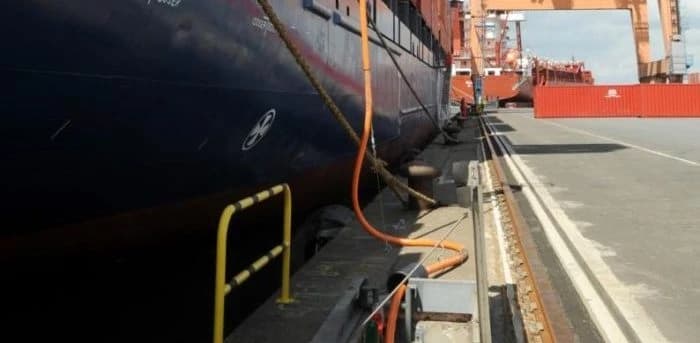
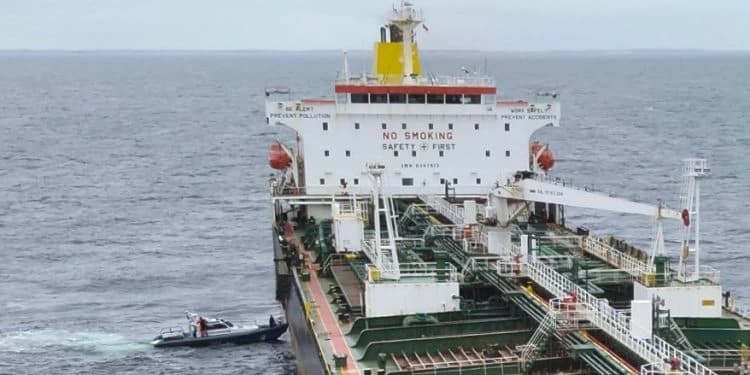
To address that gap, the study proposes unmanned battery vessels that would meet commercial ships, deliver electrical power for propulsion during suitable parts of a voyage and then sail back to port to recharge. By moving energy storage off the commercial vessel itself, the concept is intended to spread battery use across multiple ships and improve utilization without requiring every ship to carry a large battery pack.
What the study found
Using global emissions data and a geographical model of possible operating corridors, the research arrives at several findings about the scale of potential coverage. It says around 62% of global shipping greenhouse gas emissions could potentially be addressed through battery electrification, including inland shipping, while onboard batteries alone would reach about 20%.
- About 56% of seagoing shipping CO₂ emissions occur within corridors that dedicated battery vessels could potentially serve.
- Near-land waters account for 65% of seagoing shipping CO₂ emissions, and roughly 82% of those emissions are geographically accessible to battery vessels before sea-state limits are applied.
- European waters account for 28% of global seagoing emissions accessible to battery vessels, while East Asian waters account for 27%.
- About 12,000 dedicated battery vessels would be needed to meet estimated seagoing propulsion energy demand at scale.
The study also says sea conditions are not a major barrier to geographic access because much of the proposed network follows relatively sheltered coastal waters. Even with a stricter operating limit of significant wave heights of up to 2.5 meters, approximately 58% of global shipping emissions would still remain potentially addressable. The author stresses that these results describe geographic possibility rather than a prediction of how quickly the technology will be adopted or how much emissions will actually fall.
Which shipping segments could adopt the technology first
The study points to cruise shipping as a possible early user, especially in the Mediterranean, where coastal routes, existing electric propulsion systems, expanding shore power infrastructure and regional carbon pricing could all support deployment. Container shipping is also identified as a likely candidate because it combines high propulsion power demand with predictable schedules and frequent operations along major coastal corridors.
Estimated accessibility of modeled major shipping routes varies widely by vessel type, and the study presents the figures as an indicator of relative fit rather than absolute electrification potential. Ferry and Ro-Ro 84% Cruise 70% Container 44% General cargo and breakbulk 40% Gas carriers 31% Tankers 30% Dry bulk 25%
Tankers and bulk carriers may face greater constraints because they often make longer open-ocean voyages, follow less regular schedules and, in some cases, require less propulsion power. The paper says those characteristics could limit how quickly they can take advantage of at-sea electrification.
Cost estimates and carbon pricing
The economic analysis suggests battery vessels could compete with conventional fuel oil under favorable market conditions, especially if battery prices fall and carbon pricing rises. In the study’s baseline scenario, the levelized cost of delivered electrical energy is estimated at $227/MWh, compared with about $115/MWh for conventional fuel oil and associated engine maintenance.
The same scenario includes a break-even carbon price of approximately $173 per tonne of CO₂ equivalent, a future battery pack price of $100/kWh and a charging cost of $65/MWh, including shore infrastructure. Depending on how individual cost and utilization assumptions change, the break-even carbon price ranges from roughly $115 to $245 per tonne of CO₂ equivalent.
Battery pack costs are identified as the most influential economic factor, followed by propulsion power demand, electricity prices and battery vessel utilization. The researcher also says battery vessels could potentially sell electricity back to the grid while in port, which would improve their business case.
Operational and regulatory hurdles remain
Despite the large theoretical opportunity, the report says broad deployment would still require substantial investment, technical progress and coordination across shipping. It identifies several enabling conditions that would need to be in place before a battery vessel network could develop at scale.
- Development of standardized electrical coupling interfaces.
- Establishment of classification rules for at-sea electrical power transfer.
- Appropriate liability and insurance arrangements.
- Expansion of port charging infrastructure.
- Adoption of compatible electric or hybrid propulsion systems onboard commercial vessels.
- Coordination between independently owned, operated and flagged ships.
The study says deployment would likely begin within individual regions or among individual operators before spreading into broader shipping networks. Open-ocean voyages would still fall outside the reach of the proposed system, but the findings suggest that direct electrification could reduce shipping’s future dependence on alternative marine fuels.
the volume of zero-carbon fuels required to decarbonize shipping by mid-century could be considerably lower than current fuel-centered projections suggest.
On that basis, the paper concludes that at-sea electrical power delivery deserves more attention in deep-sea shipping decarbonization research and in long-term transition planning.