KR highlights safety challenges facing nuclear-powered ships
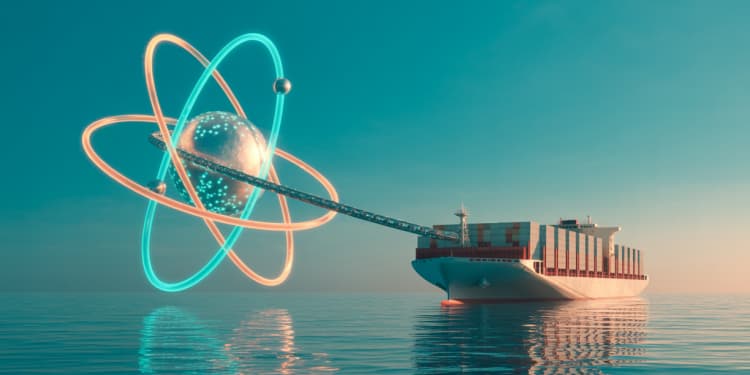
The development of nuclear-powered commercial ships presents significant safety challenges, particularly in reactor design, emergency preparedness, radiation protection and regulatory oversight, according to Korean Register (KR).
In its October 2026 Decarbonization Magazine, KR examined the technical and regulatory requirements for applying small modular reactors (SMRs) and other nuclear technologies to maritime operations. The analysis, authored by Sangick Lee, Section Head of KR’s System Safety Research Team, emphasizes that the safe deployment of nuclear propulsion will depend on integrating reactor safety with vessel design and the demanding conditions experienced at sea.
While nuclear propulsion offers the potential for long-duration operations without frequent refueling and no direct carbon dioxide emissions during operation, KR stresses that reactor technology developed for land-based facilities cannot simply be transferred to ships without addressing maritime-specific hazards.
Ship motion and reactor safety pose technical challenges
One of the central challenges identified by KR is ensuring that nuclear reactors can operate safely under the dynamic conditions experienced by vessels.
Unlike stationary nuclear facilities, ships are continuously exposed to rolling, pitching, heaving, vibration, shock and changing angles of inclination. These conditions can affect reactor cooling systems, fuel arrangements, control rod mechanisms and safety instrumentation.
As highlighted, particular attention is required for passive safety systems, which rely on natural processes such as gravity-driven cooling rather than powered equipment.
Their effectiveness may be affected by vessel movements and inclination, potentially requiring a combination of passive and active safety systems.
KR highlights several technical safety considerations:
- Reactor cooling: Ensuring reliable cooling and heat removal under vessel motion and varying operating conditions.
- Control and shutdown systems: Maintaining reliable reactor control and emergency shutdown capabilities during rolling, pitching and inclination.
- Structural protection: Preventing collisions, groundings and flooding from compromising critical reactor safety functions.
- System reliability: Protecting reactor components and instrumentation against vibration, shock and other maritime operating conditions.
According to KR, reactor safety and conventional ship safety must be considered together to prevent maritime incidents from escalating into nuclear emergencies.
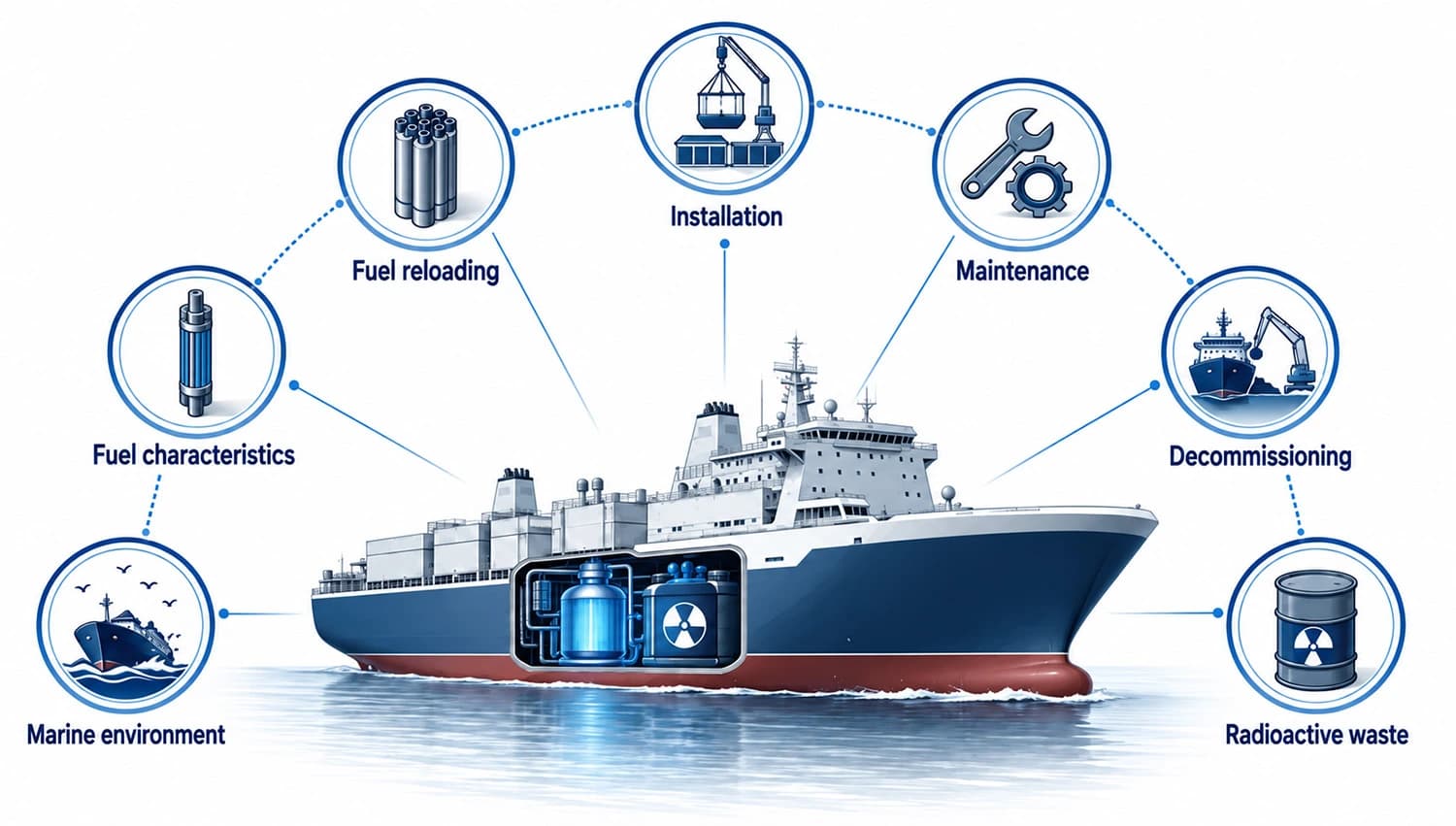
Radiation protection and vessel stability require integrated design
KR identifies space and weight limitations as additional challenges for nuclear-powered commercial ships.
Furthermore, reactor installations require radiation shielding, containment structures, cooling equipment, electrical systems and designated radiation-controlled areas, all of which must be incorporated into the vessel’s design.
Radiation shielding is essential for protecting crew members, but its additional weight can affect the vessel’s center of gravity, stability and cargo-carrying capacity.
Consequently, KR stresses that reactor layout, hull structures and propulsion systems must be developed together from the earliest design stages.
The selection of nuclear fuel also requires careful assessment of fuel lifetime, thermal stability, chemical characteristics and nonproliferation requirements.
Maintenance and emergency preparedness at sea
The limited availability of specialist personnel and maintenance facilities during voyages creates another operational challenge.
KR notes that nuclear-powered ships must distinguish between inspections and maintenance that can be performed onboard and activities requiring specialized port facilities or shore-based support.
The report identifies several approaches to improving reactor reliability, including remote monitoring to assess operating conditions and condition-based maintenance that uses equipment performance data to guide maintenance activities.
It also highlights the importance of fault-tolerant design to maintain essential functions in the event of equipment failures, alongside long-life components that reduce the need for frequent maintenance.
Extended refueling cycles could further improve operational safety by limiting nuclear fuel handling and reducing dependence on specialized refueling infrastructure.
KR notes that some next-generation reactor concepts aim to operate without refueling throughout a vessel’s service life. Such designs could reduce fuel-handling operations and associated safety and security risks, although they remain technology-dependent objectives.
The findings also highlight the importance of preparing for accidents in locations where specialized external assistance may not be immediately available.
Radioactive waste and decommissioning present further risks
KR identifies radioactive waste management and decommissioning as important considerations that must be addressed from the earliest design stages.
Unlike conventionally powered vessels, nuclear ships require arrangements for handling radioactive materials and managing the eventual retirement of reactor systems.
Potential waste streams include spent nuclear fuel, contaminated components, filters, resins and materials generated during maintenance or decommissioning.
To reduce worker exposure and improve the safety of these operations, KR highlights several design considerations:
- Incorporating accessible reactor compartments and maintenance areas.
- Selecting materials and arrangements that facilitate decontamination.
- Using long-life components and simplified systems to minimize radioactive waste generation.
- Considering modular reactor configurations that could allow the removal of entire reactor units during decommissioning.
- Establishing arrangements for radioactive waste handling and transfer to appropriate facilities.
According to KR, incorporating these requirements during initial design could reduce the complexity of maintenance and end-of-life operations.
IMO advances revision of nuclear ship safety regulations
Beyond technical considerations, KR highlights the need to modernize international regulations governing nuclear-powered merchant ships.
The existing IMO Code of Safety for Nuclear Merchant Ships was adopted in 1981 and was largely developed around conventional pressurized water reactor technology.
According to KR, the framework does not sufficiently reflect newer reactor concepts, advanced passive safety systems or current approaches to nuclear safety, security and safeguards.
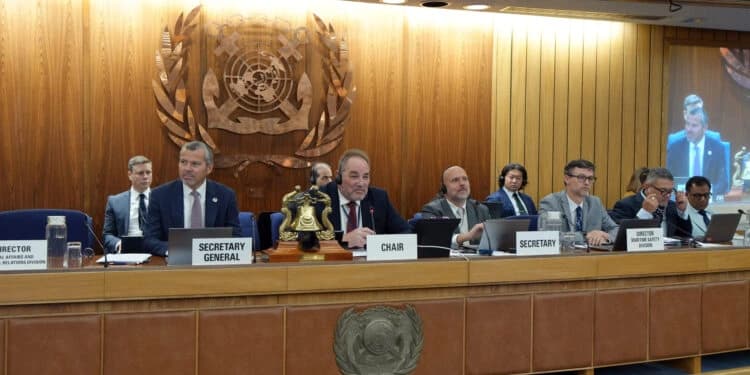
At its 110th session in June 2025, the IMO Maritime Safety Committee (MSC 110) instructed the Sub-Committee on Ship Design and Construction (SDC) to revise the Nuclear Code and review the relevant provisions of Chapter VIII of the International Convention for the Safety of Life at Sea (SOLAS).
The SDC subsequently finalized a regulatory work plan in January 2026, which was endorsed by MSC 111 in May 2026.
Under the current schedule, the IMO aims to:
- 2030, SDC 16: Finalize the revised Nuclear Code and amendments to SOLAS Chapter VIII.
- 2030, MSC 117: Approve the proposed SOLAS amendments.
- 2030, MSC 118: Adopt the revised Nuclear Code and associated SOLAS amendments.
The revisions are intended to reflect developments in nuclear technology and establish an updated safety framework for future nuclear-powered merchant ships.
International cooperation needed for nuclear safety oversight
KR also emphasizes the need for closer cooperation between the IMO and the International Atomic Energy Agency (IAEA), particularly where maritime safety requirements intersect with nuclear safety, security and safeguards.
In August 2026, the IAEA launched its Atomic Technologies Licensed for Applications at Sea (ATLAS) initiative during a high-level forum in Washington, D.C.
The initiative seeks to support the safe, secure and peaceful development of nuclear technologies for maritime applications, including nuclear-powered ships and floating nuclear power plants.
ATLAS addresses challenges involving nuclear licensing, maritime classification, safety standards, nuclear security and international regulatory coordination.
KR identifies several issues requiring further international cooperation:
- Regulatory responsibilities: Clarifying the roles of flag States, port States and national nuclear regulatory authorities.
- Safety assessment: Developing compatible approaches to reactor licensing, inspection and technical verification.
- Port access: Addressing the operational and regulatory requirements for nuclear-powered ships entering different jurisdictions.
- Emergency preparedness: Coordinating maritime and nuclear authorities in responding to potential reactor incidents.
- Nuclear security and safeguards: Establishing appropriate arrangements for nuclear materials used aboard commercial vessels.
KR is contributing to these discussions through cooperation with international organizations and a joint working group with the Korea Atomic Energy Research Institute (KAERI), involving nuclear specialists, regulators, shipyards and shipping companies.