USCG 2025: BWMS reliability is improving but gaps persist

According to U.S. Coast Guard (USCG)’s Annual Report for 2025, performance data indicates a continued improvement in Ballast Water Management System (BWMS) operational reliability, with system-related issues declining by 22.2% compared to the previous year.
Enforcement trends
As informed, over the preceding 24-month period, enforcement remained measured, with five Letters of Warning (LOW) issued. The U.S. Coast Guard continues to monitor compliance closely. The persistent issues, particularly among General Bulk Carriers, signal that this vessel type will be a key area of focus for future compliance and enforcement efforts.
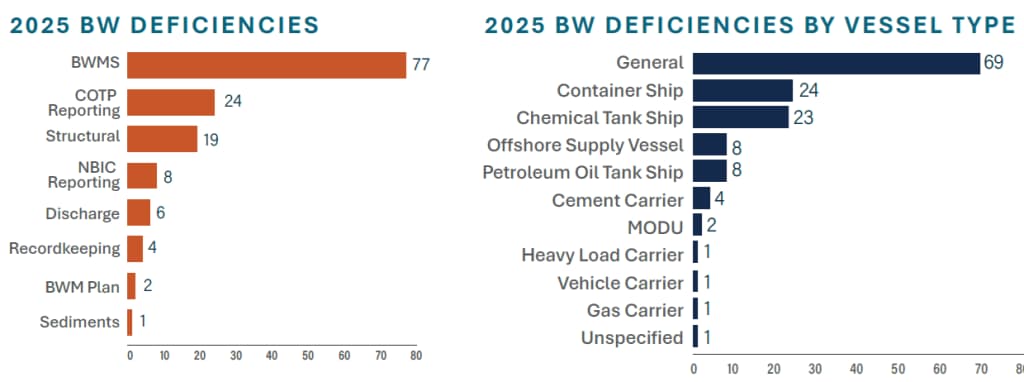
Deficiency categories definitions
- Sediments: Deficiencies are issued for failure to remove sediment, unapproved discharge of sediment.
- BWM plan: Deficiencies are issued for missing or inadequate plan onboard.
- Recordkeeping: Deficiencies are issued for failure to correctly maintain the Ballast Water Record Book.
- Discharge: Deficiencies are issued when a vessel discharges non-compliant ballast water.
- Nbic reporting: Deficiencies are issued for failing to properly report ballast practices to the National Ballast Information Clearinghouse (NBIC) within required timelines.
- Structural: Deficiencies record failures in ballast water tanks and associated piping.
- COTP reporting: Deficiencies are issued when a vessel fails to report an inoperable system to the USCG.
- BWMS: Deficiencies include both inoperable Coast Guard Type Approved systems and inoperable accepted Alternative Management Systems.
Deficiencies concentrated in specific sectors
Despite this improvement, BWMS remains the most frequent deficiency category (77 instances). These deficiencies are concentrated in three specific sectors: General Bulk Carriers (25), Container Ships (19), and Chemical Tank Ships (16). Similarly, deficiencies for failing to notify the COTP of system malfunctions fell to 24 instances this year.
Despite a 17.2% improvement in reporting, General Bulk Carriers continue to be the primary driver of this deficiency, accounting for 17 of the 24 reported cases.
To remind, according to RiSK4SEA’s insights from the total period of 90 days of the 2025 CiC on Ballast Water Management, over 90% of all findings are concentrated in just four areas:
- Ballast Water Record Book (BWRB)
- Ballast Water Management System (BWMS)
- Ballast Water Management Plan (BWMP)
- Crew Training & Familiarization
Structural deficiencies
Structural deficiencies rose to 19 total deficiencies this year (up from 8 last year), with General Bulk Carriers having the highest concentration of these incidents. Issues related to discharges also increased, though they represent a very small number of absolute cases, rising from 2 to 6 total deficiencies.
Low figures do not always mean improvement
BWM Plan issues were limited to 2 cases, found exclusively on General Bulk Carriers. However, whether these low figures represent a positive indicator of compliance or point to challenges in the detection and reporting of such incidents remains an open question that warrants further monitoring.