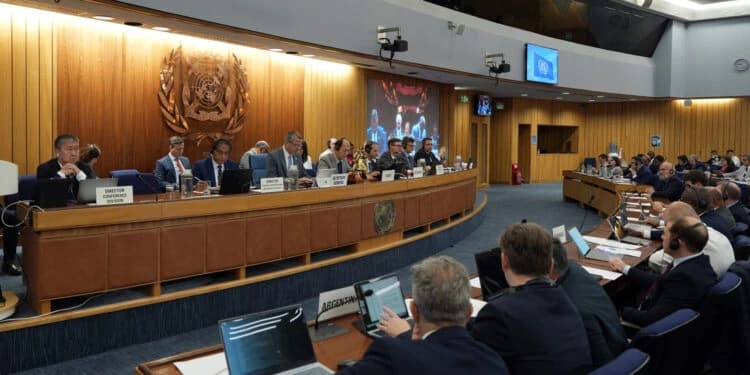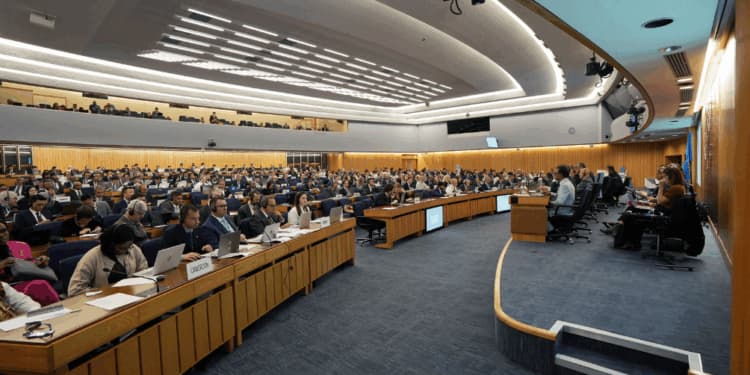
The 12th session of IMO’s Sub-Committee on Carriage of Cargoes and Containers, or CCC 12, took place from 14 to 18 September and advanced work on alternative fuels, onboard carbon capture, cargo safety, dangerous goods and cargo securing. The Sub-Committee on Carriage of Cargoes and Containers deals with the safe carriage of solid and liquid bulk cargoes, dangerous goods and containers, as well as the safety of alternative fuels and new technologies.
Following the session, Lloyd’s Register provided an overview of some of the significant outcomes from CCC 12. CCC 12 finalized the revision of the Interim Guidelines for the Safety of Ships Using Methyl/Ethyl Alcohol as Fuel, MSC.1/Circ.1621, adding requirements covering toxicity, bunkering, fire safety, ventilation, personnel protection and emergency procedures. The revised alcohol-fuel guidelines are expected to be approved by MSC 113 in June 2027. Work continued on guidelines for low-flashpoint oil fuels, fuel cell power installations and onboard carbon capture and storage, with several items to continue intersessionally and further work expected at CCC 13.
Draft amendments to the IMSBC and IMDG Codes were progressed, including new cargo schedules, improved cargo information requirements, provisions for sodium-ion and lithium batteries, and clarifications for self-reactive substances and organic peroxides. The revision of the IMO/ILO/UNECE Code of Practice for Packing of Cargo Transport Units, or CTU Code, was agreed, and a revised Code will be submitted to MSC 112 for approval. CCC 12 also agreed to establish a permanent Technical Body to oversee the CTU Code’s future maintenance.
Draft amendments to the Cargo Securing Manual guidelines were finalized, introducing harmonized performance standards for lashing software used on containerships. A proposal for a standardized method to assess container securing arrangements under the CSS Code was also agreed, with completion targeted for 2030. CCC 12 finalized the revision of MSC.1/Circ.1621 taking into account industry experience since the guidelines were adopted in 2020. The revised guidelines include provisions covering toxicity risks and associated risk assessments and alarms, alignment with the IBC Code, cofferdams and gas detection, bunkering stations and vapour return lines, independent fuel tanks and secondary enclosures, vent pipes and pressure or vacuum relief systems, oxygen sensors, materials and ventilation requirements, and personnel protection, training, drills and emergency exercises.
Work continued on new Interim Guidelines for ships using oil fuels with a flashpoint between 52°C and 60°C, developed as goal-based provisions for alternative design arrangements under SOLAS regulation II-1/55. Finalization of the low-flashpoint oil fuel guidelines was delayed by one year, and a correspondence group will further develop the provisions ahead of CCC 13. The revision of the Interim Guidelines for the Safety of Ships Using Fuel Cell Power Installations, MSC.1/Circ.1647, will continue through correspondence.
Items under consideration for the fuel cell guidelines include the classification of fuel cell spaces, ventilation requirements, fire-protected boundaries, high-temperature fuel cells and alignment with the IMO guidelines for ships using hydrogen as fuel. Finalization of the fuel cell guidelines is expected at CCC 13 in 2027, with approval at MSC 114 in 2028. CCC 12 began developing new goal- and risk-based Interim Guidelines for the Safety of Ships Using Onboard Carbon Capture and Storage Systems.
The onboard carbon capture guidelines will set overall safety goals and functional requirements, while detailed provisions for specific technologies will be developed as those technologies mature. Chemical absorption capture is expected to be addressed first, with other technologies possibly added later. The onboard carbon capture guidelines are expected to be finalized at CCC 14 in 2028, with approval targeted for 2029. Draft amendments to the IMSBC Code and Supplements were progressed, with several new and revised cargo schedules referred to E&T 45 for further consideration.
New schedules include untreated incinerator bottom ash, contaminated soil, direct shipping ore spodumene, mullite, kaolinite and tabular alumina. CCC 12 also considered amendments to section 4.2 of the IMSBC Code on information provided by shippers, including subsidiary hazards, MHB identification and supporting certificates. The draft IMSBC amendments are expected to be adopted by MSC 113 in June 2027, with voluntary application from 1 January 2028 and mandatory application from 1 January 2029. Work began on Amendment 44-28 of the IMDG Code, including proposals on transport documentation for damaged, defective or end-of-life sodium-ion batteries.
CCC 12 identified a potential safety gap concerning SP188 and agreed that further work is needed to address the potential fire risk from large quantities of small lithium and sodium batteries consolidated in containers. Other proposed IMDG amendments would clarify explosion hazards associated with self-reactive substances, organic peroxides and polymerizing substances. Amendment 44-28 is expected to be adopted by MSC 114 in 2028, with voluntary application from 1 January 2029 and mandatory application from 1 January 2030.
CCC 12 agreed to a comprehensive revision of the IMO/ILO/UNECE Code of Practice for Packing of Cargo Transport Units, which gives guidance for the safe packing, handling and transport of cargo in containers and other cargo transport units. A draft MSC circular containing the revised CTU Code will be prepared for submission to MSC 112 in December 2026. CCC 12 also agreed to establish a permanent Technical Body to oversee the CTU Code’s future maintenance and updating.
CCC 12 finalized draft amendments to the Revised Guidelines for the Preparation of the Cargo Securing Manual, MSC.1/Circ.1353/Rev.2. The amendments introduce an interim performance standard for lashing software covering functionality, calculation methods, tolerances, approval, testing, surveys, data exchange and integration with external systems. The revised guidelines are expected to be approved by MSC 113 in June 2027, and for container ships with a keel laid date on or after 1 July 2027, the revised guidelines, including the new lashing software appendix, are expected to apply.
CCC 12 agreed to develop a new annex to the CSS Code containing a standardized method for assessing the efficiency of container securing arrangements, with completion targeted for 2030.