BWM compliance checked: RISK4SEA shares preliminary CIC results
With this year’s Concentrated Inspection Campaign (CIC) on Ballast Water Management (BWM) now underway, RISK4SEA presents insights from the first 45 days, revealing that ballast water recordkeeping, system operation, management plans, and crew training are key areas of focus.
Through this update, RISK4SEA provides early insights into the CIC’s progress, key findings, inspection intensity, and emerging trends as the campaign continues.
To recap, the Paris MoU and Tokyo MoU launched a Concentrated Inspection Campaign (CIC) on Ballast Water Management (BWM) on 1 September, running until 30 November 2025. Similar campaigns during the same period have also been initiated by other MoUs, including the Indian Ocean, Mediterranean, Black Sea, and Viña del Mar MoUs.
The campaign aims to assess global compliance with the BWM Convention (2004), focusing on the following key areas:
- Approval and updating of the Ballast Water Management Plan (BWMP)
- Crew training and familiarity with system operations
- Accuracy and maintenance of the Ballast Water Record Book (BWRB)
- Approval and operational condition of BWMS equipment
- Verification of BWM certification and exemptions
- Procedures for sediment management and disposal
Key findings to date
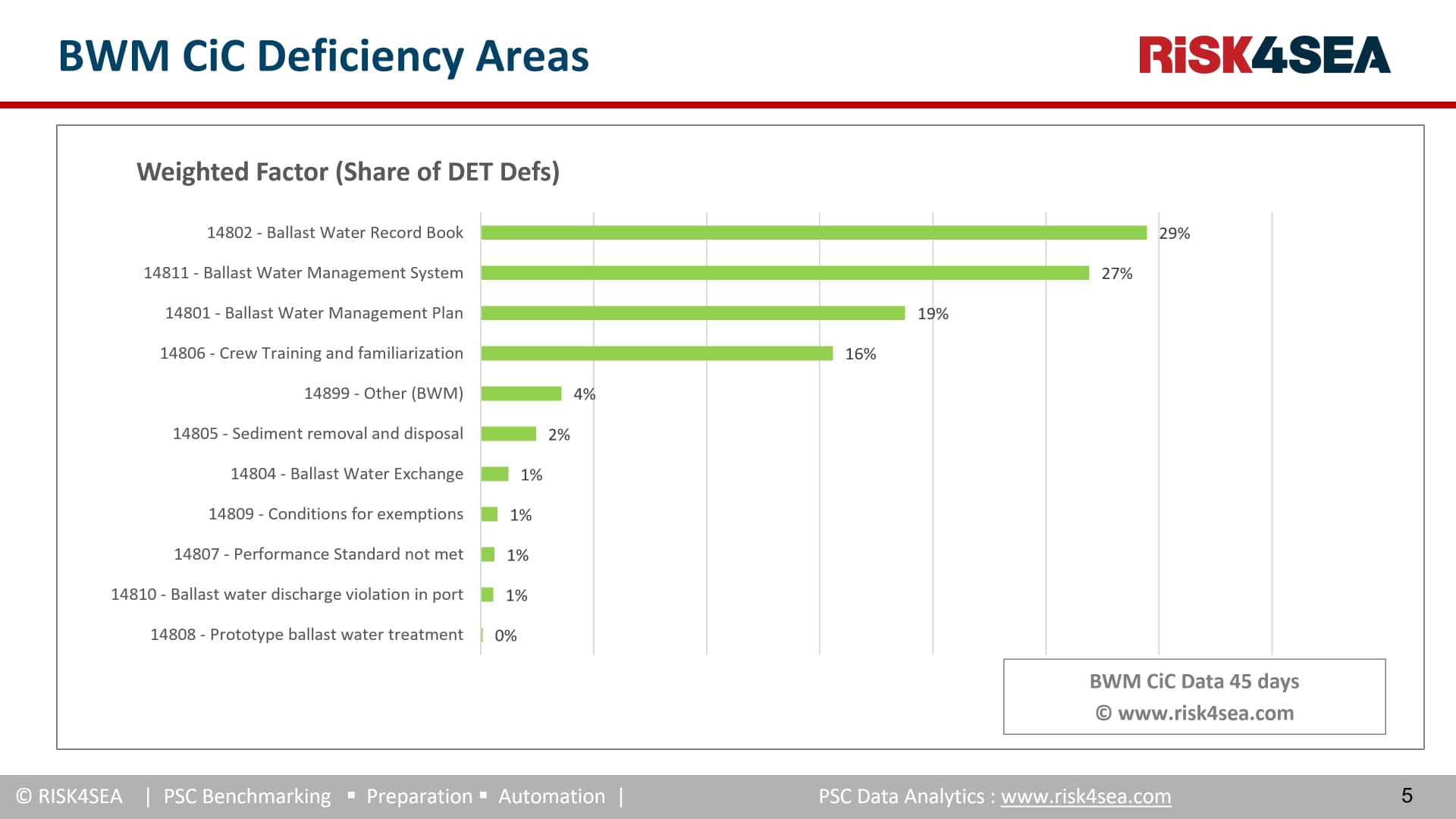
#1 Four core areas dominate
Over 90% of all findings are concentrated in just four areas:
- Ballast Water Record Book (BWRB)
- Ballast Water Management System (BWMS)
- Ballast Water Management Plan (BWMP)
- Crew Training & Familiarisation
#2 Limited focus on operational procedures Contrary to industry concerns, Ballast Water Exchange, Discharge in Port, and Sediment Removal & Disposal have not emerged as major sources of deficiencies.
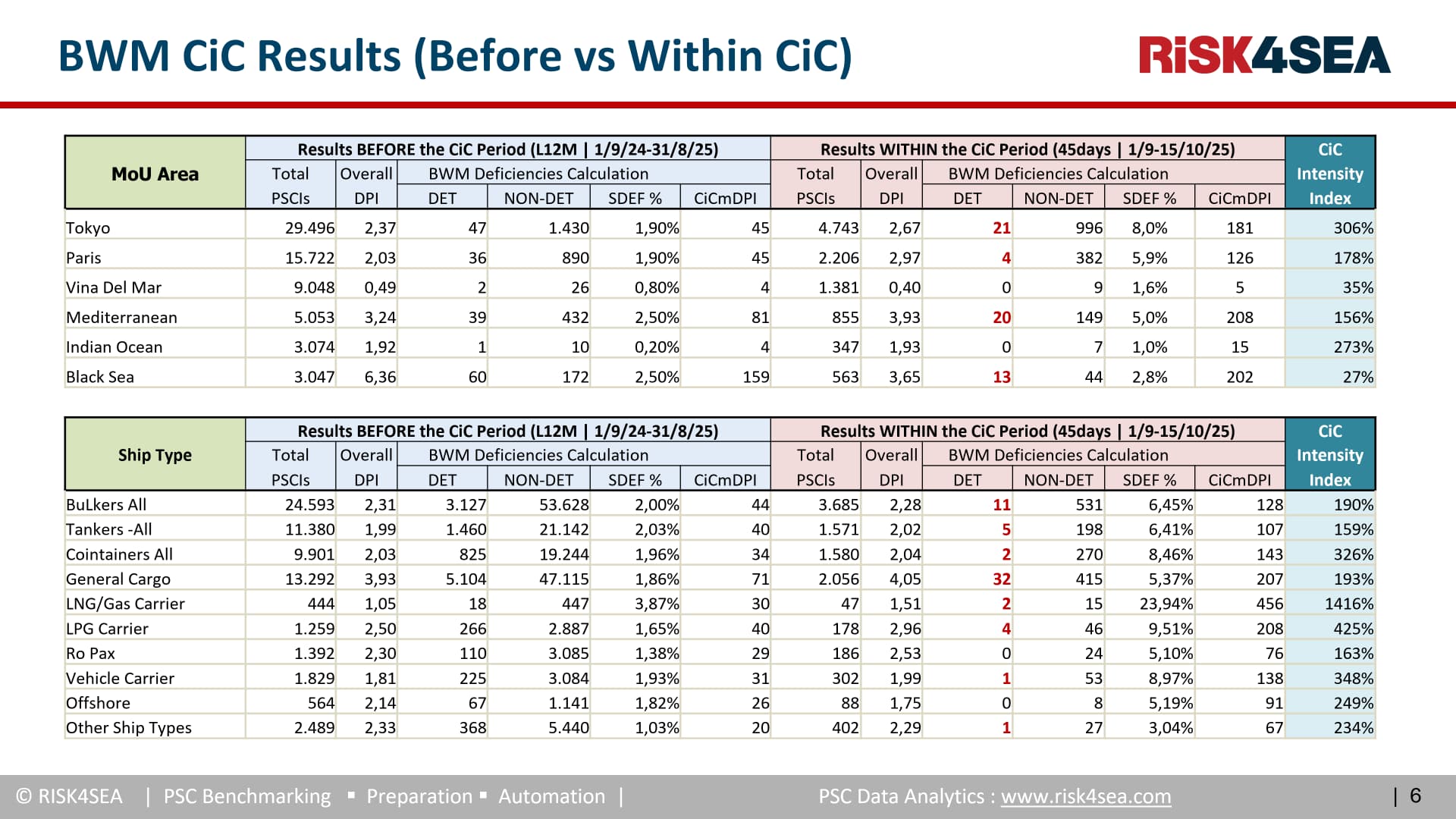
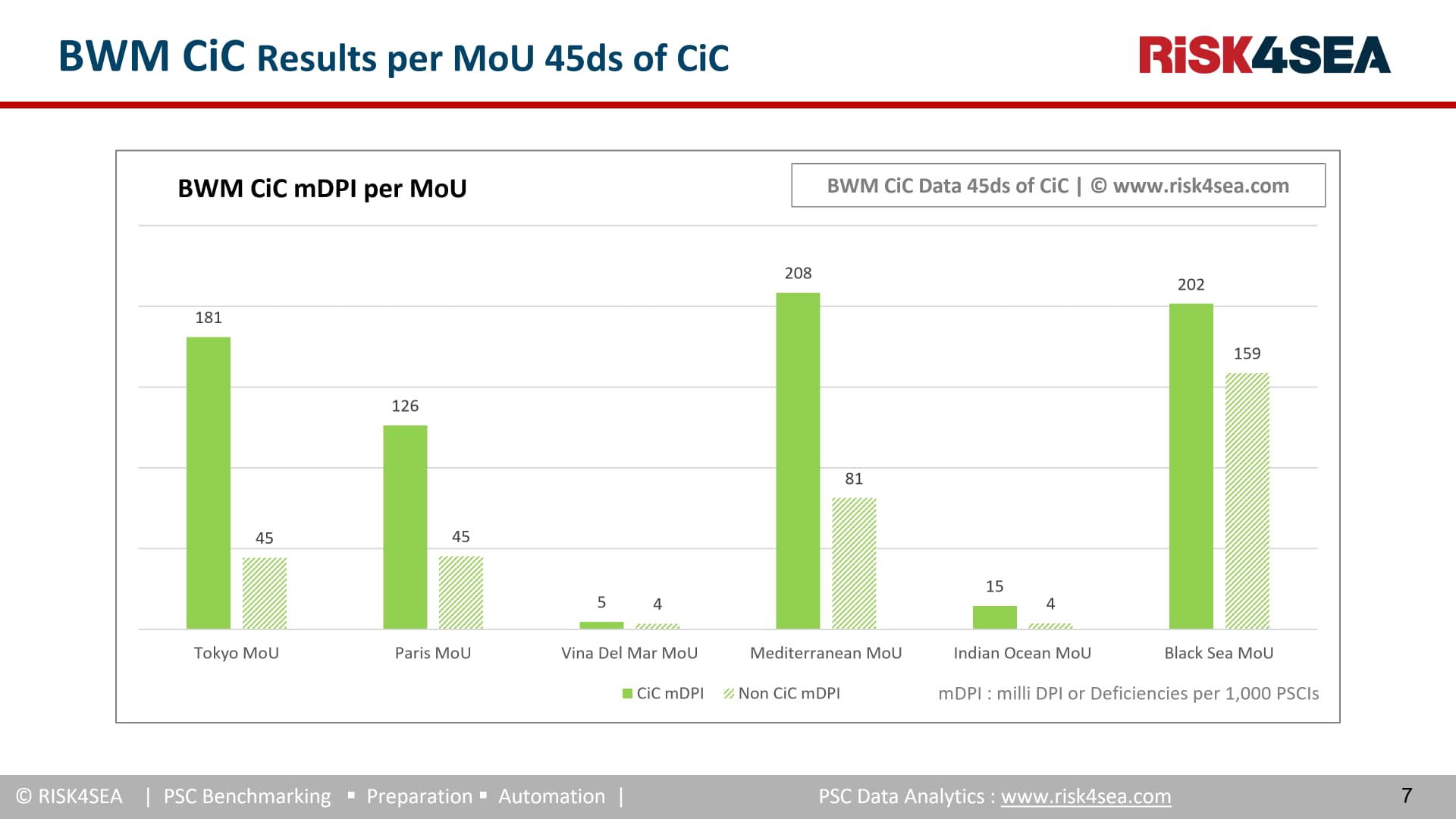
#3 Uneven CiC enforcement across MoUs Despite formal announcements, only Tokyo MoU, Paris MoU, and Mediterranean MoU are actively prioritizing the BWM CiC according to the CiC Intensity Index.
#4 Intensity comparison (vs pre-CiC period)
- Tokyo MoU: ~3× higher focus intensity
- Paris & Mediterranean MoUs: ~2× higher focus
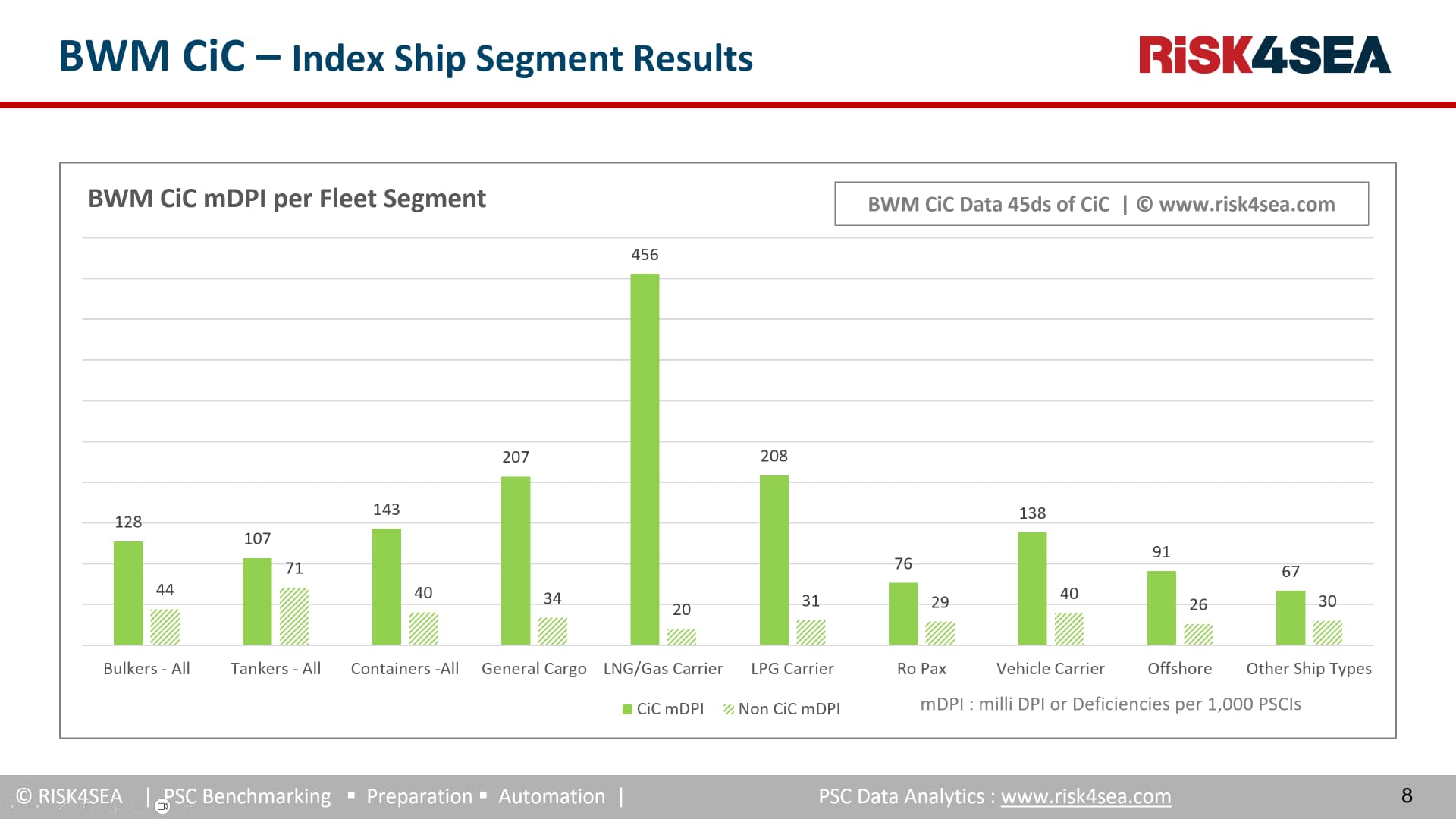
#5 Ship types most impacted LNG carriers face the highest inspection pressure, followed by LPG carriers and Vehicle Carriers. Other ship types experience approximately double the scrutiny compared to pre-CiC levels.
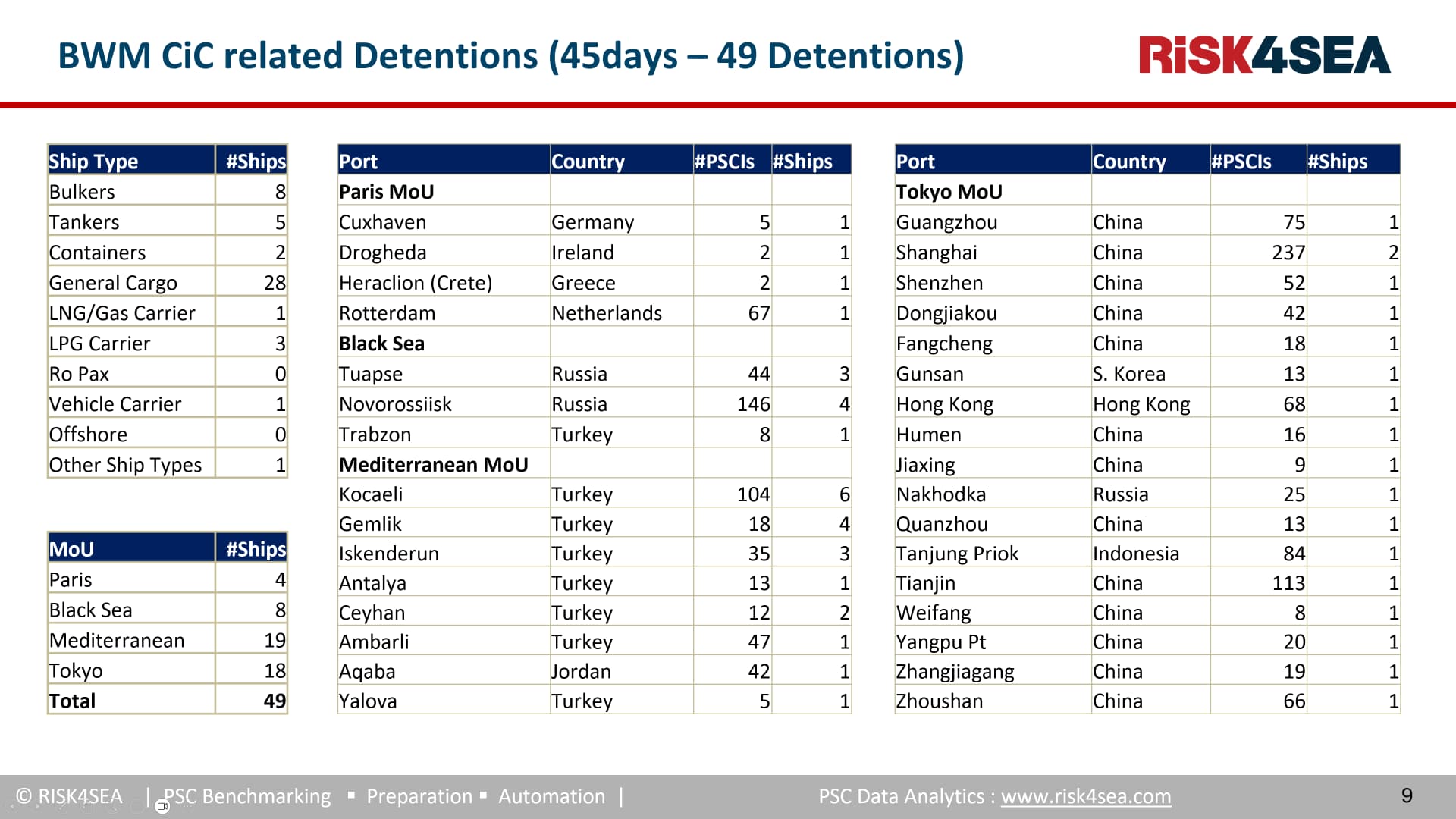
#6 Detentions Analysis General Cargo is by far the most affected ship type attracting more than 50% of the Detentions. Mediterranean & Tokyo are leading by the Number of Detentions with record of detentions also to the Paris & Black Sea MoU
Severity-weighted analysis [ for the first 45 days of the CIC ]
A severity-weighted breakdown of these findings is included in the next section, highlighting critical risk areas and high-impact deficiencies affecting operational compliance.
Deficiency Code Area Description Detainable Deficiencies NON- Detainable Deficiencies TOTAL Deficiencies 14801 Ballast Water Management Plan 9 309 318 14802 Ballast Water Record Book 1 616 617 14804 Ballast Water Exchange 2 6 8 14805 Sediment removal and disposal 0 52 52 14806 Crew Training and familiarization 9 241 250 14807 Performance Standard not met 1 3 4 14808 Prototype ballast water treatment 0 2 2 14809 Conditions for exemptions 1 6 7 14810 Ballast water discharge violation in port 1 2 3 14811 Ballast Water Management System 31 262 293 14899 Other (BWM) 2 56 58 TOTAL 57 1,555 1,612
Severity Weighted findings analysis as follows for the first 45 days of the CIC
Analysis per each of the MoU as follows, comparing the same Deficiency Areas affected by the CIC (Referred to as CIC Deficiency Per Inspection or CIC mDPI, milli DPI or Deficiencies per 1000 PSCIs), along with the calculation of the CIC intensity Index (Methodology of the Index in Annex C)
The Analysis of overall Findings in terms of BWM CiC mDPI the 12 months before and during the period of the CiC are as follows:
Annex A – CiC Questionnaire
No. Description 1. Is a valid International Ballast Water Management Certificate (IBWMC) on board? (01136 – BWM 2004 / Reg. E-2) 2. Is the approved Ballast Water Management Plan (BWMP) on board? (14801- BWM 2004 / Reg. B-1) 3. Is the BWMP up to date to reflect the applicable requirements to manage Ballast Water as required by the Convention? (14801- BWM 2004 / Reg. B-1) 4. Are officers and crew familiar with their duties in the implementation of the BWMP? (14806 – BWM 2004 / Reg.B-6) 5. Is the Ballast Water Management System (BWMS) approved by the Administration/Organization, as appropriate? (14812 – BWM 2004 / Reg. D-3 or BWMS Code) 6. Is the BWMS operational? (14811 – BWM 2004 / Reg. D-2 or BWMS Code Section 4) 7. Was the Ballast Water managed according to the BWMP? (14813 – BWM 2004 / Reg. B-1) 8. Is the Ballast Water Record Book (BWRB) properly filled including exemptions if granted? (14802- BWM 2004 / Reg. B-2 & Reg. A-4.4) 9. Is the crew managing Ballast Water sediments in accordance with the BWMP? (14805 – BWM 2004 / Reg. B-5) 10. If an exemption has been granted, are the conditions of exemption implemented? (14809 – BWM 2004 / Reg. A-4)
Annex B – Guidance on Qs for the BWM CiC
- Is a valid International Ballast Water Management Certificate (IBWMC) on board? (01136 – BWM 2004 / Reg. E-2)
Each Ship applicable to Ballast Water Convention should have a valid International Ballast Water Management Certificate (IBWMC) on board. Specifically, ships of 400 gross tonnage and above, with some exceptions, are required to carry this certificate, along with an Approved Ballast Water Management Plan and a Ballast Water Record Book.
- Is the approved Ballast Water Management Plan (BWMP) on board? (14801- BWM 2004 / Reg. B-1)
All ships in international traffic are required to have an approved Ballast Water Management Plan (BWMP) on board, as mandated by the International Convention for the Control and Management of Ships’ Ballast Water and Sediments, 2004 (BWM Convention). This plan should be ship specific and should include details how the vessel will manage its ballast water to minimize the risk of transferring harmful aquatic organisms and pathogens. All related methods used on board to handle ballast water should be included in the BWMP.
- Is the BWMP up to date to reflect the applicable requirements to manage Ballast Water as required by the Convention? (14801- BWM 2004 / Reg. B-1)
The Ballast Water Management Plan (BWMP) must be up-to-date to reflect the applicable requirements of the Convention. BWMP to be approved by the Administrator or a Recognized Organization (RO) on behalf of the Administrator. The plan should include instructions for ballast water exchange (BWE) as per D-1 standard, ballast water management system (BWMS) as per D-2 standard, or other methods approved by the Marine Environment Protection Committee (MEPC).
- Are officers and crew familiar with their duties in the implementation of the BWMP? (14806 – BWM 2004 / Reg.B-6)
According to the BWM Convention (specifically Regulation B-6), officers and crew are required to be familiar with their duties in implementing the ship’s Ballast Water Management Plan (BWMP). This includes understanding the specific procedures related to their ship’s BWMP and the systems and equipment used on board. Relevant section should also be included in BWMP. In some cases Port State Control Officers may require a demonstration from the crew on how to used BWMS and related components.
- Is the Ballast Water Management System (BWMS) approved by the Administration/Organization, as appropriate? (14812 – BWM 2004 / Reg. D-3 or BWMS Code)
The Ballast Water Management Plan (BWMP) must be approved by the Administrator or a Recognized Organization (RO) on behalf of the Administrator. Any correction or change or revision should also be approved by the Administrator or an RO (on behalf of the Administrator). Ship should have evidence that the ballast water management system is type approved and has been maintained and operated in accordance with the ships’ Ballast Water Management Plan.
- Is the BWMS operational? (14811 – BWM 2004 / Reg. D-2 or BWMS Code Section 4))
BWMS onboard should be in adequate operation condition. In case of malfunction any effort should be made for rectification. The PSC authorities should be notified in advance in case of inoperative BWMS, and a flag dispensation to be obtained. In any case their BWMP should include emergency and alternative methods in case of BWMS inoperability. A rectification plan should be available in order to be demonstrated to PSCOs. Ship’s PMS to include actions and inspections for all BWMS components. A set of spares should be available on board as per manufacturers requirements.
- Was the Ballast Water managed according to the BWMP? (14813 – BWM 2004 / Reg. B-1)
Evidence should be available for demonstration on how the Ballast Water was handled on board. Actions should be in accordance with the requirements of approved BWMP. Any exchange or treatment should follow the step by step actions included in the BWMS. Any deviation from the actions should be recorded and reported to the PSC authorities in advance.
- Is the Ballast Water Record Book (BWRB) properly filled including exemptions if granted? (14802- BWM 2004 / Reg. B-2 & Reg. A-4.4)
The Ballast Water Record Book (BWRB) should be properly filled, including details of any exemptions granted under the BWM Convention. Specifically, Regulation B-2 of the BWM Convention mandates the keeping of a BWRB, while Regulation A-4.4 addresses exemptions and their recording. The BWRB must include details of all ballast water operations, including uptake, transfer, and discharge. Information such as date, time, location (port or latitude/longitude), and volume of ballast water operations should also be included. The BWRB should be in an approved format (which may be an electronic record system, which may be integrated into another record book or system) and should be kept on board the ship for a minimum of two years after the last entry. The officer in charge of the operation should sign each entry in the BWRB and the Master should sign each completed page
- Is the crew managing Ballast Water sediments in accordance with the BWMP? (14805 – BWM 2004 / Reg. B-5)
Ballast Water Management Plan (BWMP) as per Regulation B-5 should address sediment management and requires ships to minimize the uptake and discharge of sediments during ballast operations. BWMP should be designed, and constructed with a view to minimize the uptake and undesirable entrapment of Sediments, facilitate removal of Sediments, and provide safe access to allow for Sediment removal and sampling. Crew should be familiar with the technics and procedures for sediment handling on board.
- If an exemption has been granted, are the conditions of exemption implemented? (14809 – BWM 2004 / Reg. A-4)
If a ship is granted an exemption under regulation A-4 of the BWM Convention, the conditions of that exemption must be implemented. Regulation A-4 allows for exemptions to be granted based on a risk assessment for specific voyages or routes, but these exemptions are not unconditional. The ship must still adhere to any conditions specified in the exemption document, which could include restrictions on where ballast water is taken up or discharged, or requirements for specific ballast water management practices.
Annex C: CIC Intensity Index Methodology
To assess the CIC Intensity Index a simple methodology has been applied based on Ballast Water Management (BWM) CIC related Deficiency expressed in mDPI (Deficiencies per 1,000 PSCIs) comparing 2 periods
- During the CIC Period (x Days) Here, Last 45 days, i.e. 1/9/2025 to 15/10/2025
- Before the CIC period (Last 12 months) and the period where CIC is being applied. Here, Last 12 months 1/9/2024 – 31/05/2025
The BWM CIC mDPI is the sum of all BWM CIC deficiency findings per ship, port, manager, MoU etc. related with the CIC

The CIC intensity index signifies the increased focus on the CIC Items
- Less than 0%: There is Less focus in the CIC Items during the CIC compared with the period before CIC
- 0% = No Increased focus at all on CIC Items during the CIC compared with the period before CIC
- 200%: 2x Focus on on CIC Items during the CIC compared with the period before CIC
- The higher the percentage of CIC Intensity Index, the higher the focus (i.e. intensity) on the CIC requirements and Findings.