BIMCO advances ISO proposal to measure GHG emissions from shipbuilding
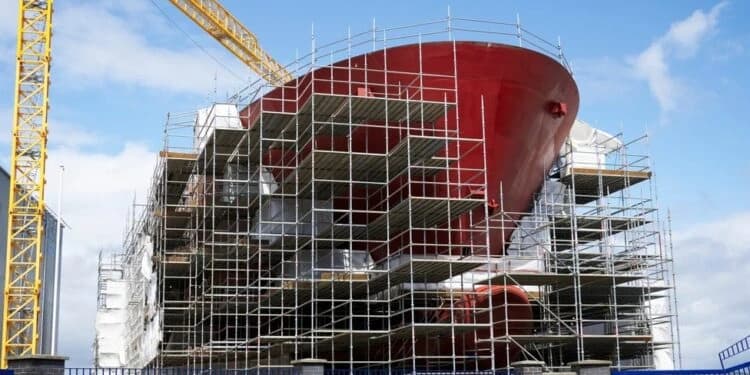
A BIMCO-led initiative has entered the ISO approval process, aiming to establish a common methodology for calculating greenhouse gas emissions generated during ship construction.
According to BIMCO, the proposed ISO Technical Specification would introduce a harmonized approach to measuring greenhouse gas (GHG) emissions throughout the shipbuilding process, from raw material extraction and component manufacturing to vessel construction and sea trials.
The proposal was developed by a BIMCO-led industry working group and formally submitted to the International Organization for Standardization (ISO) by Danish Standards on 4 October 2026. Participating national standards bodies are currently voting on the proposal, with the ballot scheduled to close on 27 December 2026.
The initiative aims to address a gap in maritime emissions accounting, as existing mandatory IMO regulations primarily focus on emissions associated with vessel operations and marine fuels rather than emissions generated before a ship enters service.
We initiated this work because the lack of a common methodology creates a gap for shipowners seeking reliable information about the lifecycle GHG emissions of their assets.
…Aron Frank Sørensen, BIMCO’s Chief Environment Officer, explained.
The proposal builds on the work of an industry working group comprising representatives from BIMCO, the China Association of the National Shipbuilding Industry, the China Shipbuilding Information Center, China State Shipbuilding Corporation (CSSC), DFDS, Everllence SE, HD Korea Shipbuilding & Offshore Engineering, the International Chamber of Shipping (ICS), the International Association of Classification Societies (IACS) and Stena Rederi AB, among others.
The proposed specification follows a cradle-to-gate approach, covering emissions generated during the following stages:
- Extraction and processing of raw materials, including steel and other construction materials.
- Manufacturing and transportation of ship components.
- Shipyard construction activities.
- Waste handling, vessel launching, testing and sea trials.
The methodology could also be applied to major vessel conversions, repairs and new equipment installed during a ship’s operational lifetime. However, it would exclude emissions from regular vessel operations, routine maintenance after delivery and activities following a ship’s arrival for recycling.
Four calculation methods proposed
The proposed methodology builds on the ISO 14040 and ISO 14060 families of standards and the GHG Protocol. It introduces four calculation approaches to accommodate different levels of available emissions data:
- Supplier-specific method: Uses emissions information provided directly by suppliers.
- Hybrid method: Combines supplier-specific data with estimates where information is unavailable.
- Average-data method: Uses average emissions factors to estimate emissions associated with materials and activities.
- Spend-based method: Estimates emissions using expenditure data.
According to BIMCO, supplier-specific data would be preferred where available, while the other methods would allow emissions estimates when detailed information cannot be obtained.
The organization expects a harmonized methodology to help shipowners, shipyards and equipment manufacturers identify emissions-intensive activities, improve sustainability reporting and reduce inconsistencies in GHG accounting.
The specification could also support shipowners reporting Scope 3 emissions voluntarily or under applicable national and regional legislation.
However, BIMCO emphasizes that the methodology would not automatically make emissions results comparable between different ships or companies, as comparability would depend on consistent calculation boundaries, data quality and assumptions.
Development timeline
The initiative originated in the Tripartite forum, which brings together shipyards, international shipowner organizations and classification societies. In November 2024, the forum agreed to establish an industry working group led by BIMCO to prepare a proposal for standardized shipbuilding emissions accounting.
The group, comprising approximately 20 participants representing shipowners, shipyards, equipment manufacturers and classification societies, developed an initial draft methodology during 2025.
Following discussions with Danish Standards, the proposal was presented to ISO’s maritime GHG reduction subcommittee in June 2026 before entering the formal ISO process in October.
If approved, technical development is expected to begin in January 2027 under ISO/TC 8/SC 25/WG 3, with completion targeted for December 2028.
BIMCO clarified that the proposal seeks to establish a Technical Specification rather than a full International Standard, allowing further technical development and practical industry input. The methodology could subsequently form the basis of an International Standard.
The organization is encouraging shipbuilders, equipment manufacturers, shipowners and other stakeholders to participate in the development process through their national standards bodies.