ICCT calls for revised IMO NOx testing standards to reflect real-world ship operations
A new ICCT study finds that existing IMO engine testing requirements do not adequately reflect real-world ship operations, particularly at low engine loads.
The International Council on Clean Transportation (ICCT) published the technical brief “Reducing NOX emissions from ships in Emission Control Areas: Recommended updates to the IMO’s Tier III, E3 test cycle” in November 2026, recommending revisions to the International Maritime Organization’s (IMO) Tier III nitrogen oxide (NOx) emissions testing requirements to better reflect actual vessel operations within Emission Control Areas (ECAs).
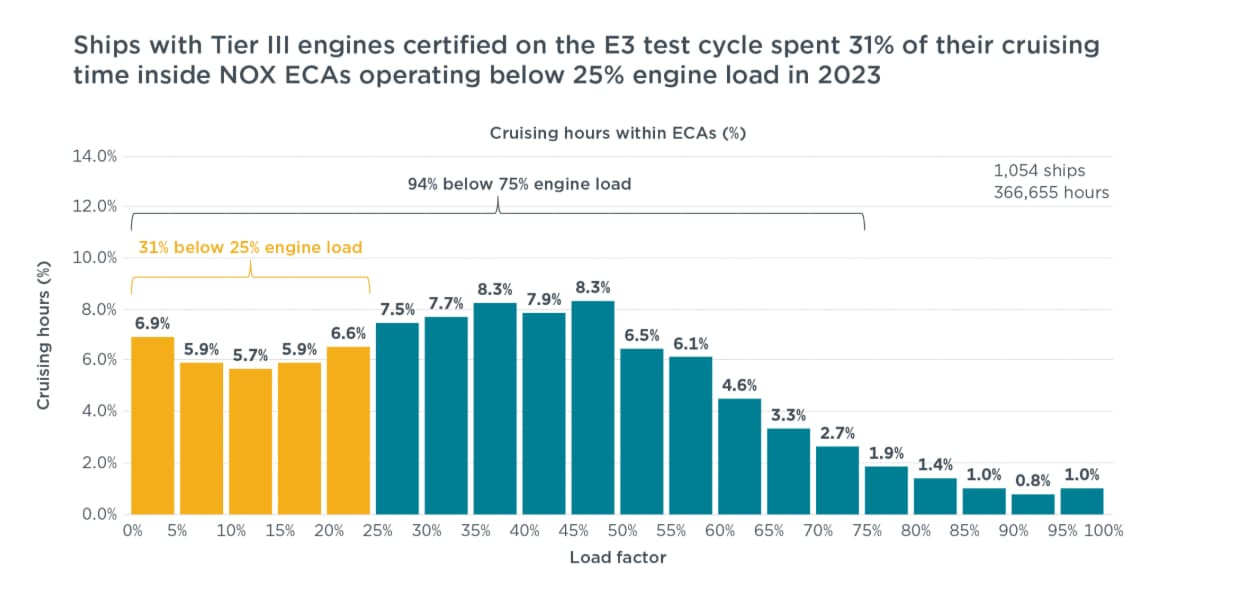
The study analyzed the operating profiles of 1,054 ships using automatic identification system (AIS) data from 2023. The findings indicate that ships frequently operate at engine loads below those covered by current certification testing, raising concerns that certified NOx emission rates may not adequately represent real-world emissions.
Under MARPOL Annex VI Regulation 13, Tier III requirements apply to qualifying newer ships operating within designated NOx ECAs. Engine certification is governed by the NOx Technical Code 2008, which specifies testing procedures and emission limits.
The current E3 test cycle measures NOx emissions at four engine loads: 25%, 50%, 75% and 100%. However, the ICCT found that actual operating conditions differ substantially from this testing profile.
Key findings
The research examined the main engine load distributions of 1,054 ships with Tier III engines certified under the E3 test cycle, focusing on operations within the North American, U.S. Caribbean Sea, Baltic Sea and North Sea NOx ECAs.
Using its Systematic Assessment of Vessel Emissions (SAVE) model and AIS data, the ICCT identified the following findings:
- 31% of cruising hours within NOx ECAs occurred below 25% engine load, the lowest point currently included in the E3 certification test cycle.
- 94% of cruising hours within NOx ECAs occurred below 75% engine load, compared with the existing test cycle’s weighting factors, which assign 70% of the weighting to engine loads of 75% and above.
- Outside NOx ECAs, ships spent 16% of their cruising hours below 25% engine load and 92% below 75% load.
- Within the North American and U.S. Caribbean Sea ECAs, ships spent 33% of cruising hours below 25% engine load, compared with 26% in the Baltic Sea and North Sea ECAs.
- Across the analyzed ships’ global operations, approximately 17% of cruising hours occurred below 25% engine load.
The ICCT noted that the existing E3 weighting factors are based on an ISO standard introduced in 1996 and have remained unchanged despite significant changes in shipping operations, including the widespread adoption of slow steaming.
The study also identified potential limitations in NOx emissions control at low engine loads. Selective catalytic reduction (SCR) systems, commonly used to achieve Tier III compliance, operate less effectively as exhaust gas temperatures decrease.
Under existing MARPOL Annex VI provisions, emissions control systems may be bypassed at low loads with flag-state approval to prevent damage to engines or emissions control equipment.
According to the ICCT, this creates a potential gap in emissions control, particularly when ships operate at reduced speeds near coastal communities, where exposure to air pollution is a concern.
Recommendations for IMO
Based on its findings, the ICCT recommends revising the NOx Technical Code 2008 to ensure that engine certification requirements better reflect actual operating conditions.
The report outlines four principal recommendations:
- Introduce a 10% engine load test point: Expand the E3 certification cycle to measure emissions at lower engine loads, where vessels frequently operate.
- Extend emissions limits to lower loads: Expand the Tier III not-to-exceed zone from 25% down to 10% engine load, preferably using a graduated emissions cap.
- Revise test-cycle weighting factors: Adjust the weighting assigned to different engine loads to better represent real-world operating profiles, placing greater emphasis on lower engine loads.
- Phase in the revised requirements: Initially apply the updated test cycle to new ships, followed by a gradual extension to existing Tier III ships over a five-year period.
The ICCT recommends increasing the weighting assigned to 25% engine load from 15% to 30%, while introducing a 15% weighting at the proposed 10% load point. At the same time, the weighting assigned to 75% engine load would decrease from 50% to 10%.
The report also recommends applying the revised requirements to engines with a power output greater than 130 kW, consistent with existing Tier III compliance provisions.
According to the ICCT, limiting the changes to engines above 5,000 kW would exclude approximately 1% of the ships examined in the study. However, the researchers noted that such a threshold could create incentives to install engines with power outputs just below the limit.
Next steps at IMO
The ICCT’s recommendations come amid ongoing discussions at IMO’s Sub-Committee on Pollution Prevention and Response (PPR) concerning potential amendments to the NOx Technical Code 2008. During PPR 13 in 2026, several submissions highlighted differences between existing engine certification requirements and real-world operating profiles.
Proposals submitted by Member States and international organizations included introducing a 10% engine load test point and reconsidering the weighting factors used in certification.
The ICCT suggests that revised requirements could initially apply to newly built vessels before being extended to existing Tier III ships over approximately five years, potentially aligning implementation with normal dry-docking cycles.
The organization also identifies opportunities for further research into Tier II certification and other engine testing cycles, including those applicable to auxiliary engines. PPR 14, scheduled for early 2027, is identified as the next opportunity to advance discussions on the proposed changes. The recommendations remain proposals and have not been adopted as IMO requirements.