Marine ethanol gains ground amid advances in engine technology
US ethanol production capacity and advances in marine engine technology could support wider adoption of ethanol as a shipping fuel, although regulatory and commercial challenges remain.
The Maritime Ethanol & Methanol Alliance (MEMA), a platform of the Global Centre for Green Fuels (GCGF), has published Marine Ethanol: Unlocking the US Opportunity, examining the potential for US-produced ethanol to support maritime decarbonization. With technical contributions from the ABS Sustainability Center in Houston, the report evaluates ethanol’s technical readiness, lifecycle emissions performance, production capacity, economic competitiveness and regulatory requirements.
The findings suggest that ethanol could become a complementary alternative to methanol and other low-emission marine fuels, benefiting from existing production infrastructure and advances in alcohol-compatible marine engines.
However, the report emphasizes that wider deployment will depend on fuel certification, engine approvals, bunkering infrastructure, regulatory recognition and commercial competitiveness.
US ethanol production offers significant supply potential
According to the report, the United States produced 16.4 billion gallons of ethanol in 2025, accounting for approximately 51% of global production.
With installed production capacity of 18.5 billion gallons annually, the country has approximately 2 billion gallons of unused capacity that could potentially supply emerging maritime fuel demand. The US also exported 2.18 billion gallons of ethanol to approximately 80 countries in 2025, supported by established rail, barge and coastal terminal networks.
MEMA estimates that supplying just 1% of global marine fuel demand would require approximately 1 billion gallons of ethanol annually, while a 5% market share by the mid-2030s would require around 5 billion gallons.
These estimates represent illustrative scenarios rather than forecasts, with actual uptake depending on fuel costs, regulatory treatment, vessel compatibility and competing alternative fuels.
The report also estimates that every billion gallons of ethanol deployed as marine fuel could generate $5 billion to $7 billion in US economic activity and support approximately 30,000 to 50,000 jobs across agriculture, fuel production, logistics and maritime operations.
Engine developments could accelerate adoption
A central finding concerns ethanol’s compatibility with existing methanol-capable propulsion technologies. According to MEMA, ethanol and methanol share several physical and chemical characteristics, allowing some existing alcohol-fuel engine platforms to be adapted for ethanol operation with relatively limited modifications.
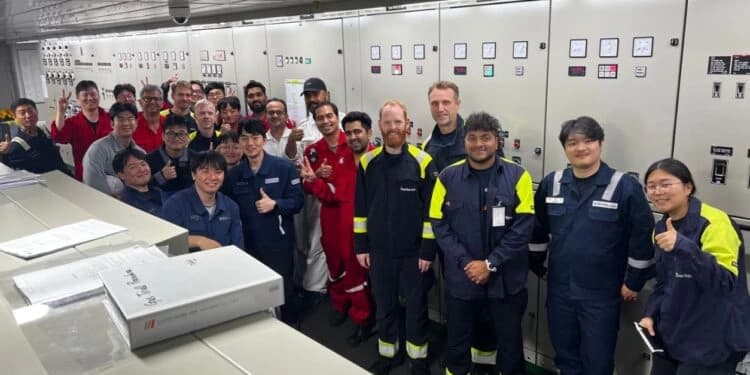
The report highlights developments involving WinGD, Everllence, Wärtsilä and Caterpillar, which have undertaken engine testing or introduced technologies designed to accommodate ethanol.
Commercial deliveries of ethanol-capable engines are expected to begin in 2027, while several vessel demonstrations have already taken place.
Among these, the report highlights Maersk’s ethanol trials aboard Laura Maersk, which progressed from blends containing 10% ethanol to 50% ethanol and, according to MEMA, testing with neat ethanol.
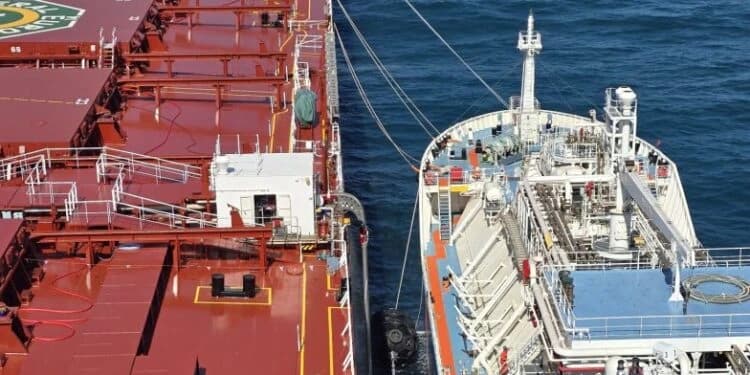
Another development occurred on September 28, 2026, when Tangier Maersk completed a commercial ship-to-ship ethanol bunkering operation in Houston using US-produced corn ethanol.
These developments demonstrate growing technical readiness, although the report acknowledges that large-scale commercial operating experience remains limited.
MEMA assigns ethanol a technology readiness level of 8, compared with 8–9 for methanol and 9 for LNG.
Ethanol could deliver emissions reductions
The report identifies potential emissions benefits from ethanol use, particularly for conventional air pollutants.
According to MEMA, ethanol combustion could deliver the following reductions compared with conventional heavy fuel oil, depending on engine technology and operating conditions:
- Sulfur oxides (SOx): Near-total elimination.
- Nitrogen oxides (NOx): Reductions of approximately 40–94%.
- Particulate matter: Reductions of approximately 90–99%.
- Greenhouse gases: Well-to-wake reductions exceeding 50% are achievable with some of the most efficient ethanol production pathways compared with very low sulfur fuel oil.
The report also identifies carbon capture and storage, renewable energy integration and improvements in agricultural practices as potential measures for further reducing the lifecycle emissions intensity of ethanol production.
However, greenhouse gas performance varies considerably depending on feedstock production, manufacturing processes, energy inputs and transportation.
As a result, MEMA emphasizes the importance of reliable lifecycle assessments, traceability and independent certification to ensure that claimed emissions reductions can be verified.
Existing infrastructure offers advantages but safety challenges remain
Unlike fuels requiring cryogenic or high-pressure storage, ethanol remains liquid at ambient temperatures and pressures. This could allow existing ethanol logistics infrastructure, as well as certain methanol bunkering facilities, to support its distribution and use as a marine fuel.
The report suggests that the availability of established production and export networks could reduce some of the infrastructure barriers associated with alternative fuel adoption.
Nevertheless, ethanol introduces specific onboard safety and operational considerations.
With a flash point of approximately 13°C, ethanol requires appropriate fire prevention arrangements, ventilation, gas detection and alcohol-compatible firefighting systems.
The report also identifies material compatibility, moisture contamination, tank inerting and crew training as important considerations.
Although many of these requirements can build on existing methanol-fuel safety practices, shipowners must ensure that equipment and procedures are suitable for ethanol before commercial operation.
Fuel costs and regulatory uncertainty could limit uptake
Despite its established production base, ethanol faces challenges in competing with conventional marine fuels on an energy-equivalent basis. The report estimates that net production costs, after accounting for coproduct revenues, can fall below $1 per gallon.
However, this does not represent the delivered cost of marine ethanol, which must also account for transportation, bunkering, fuel energy density and other operational expenses.
Ethanol has a lower volumetric energy density than conventional marine fuels, requiring additional onboard storage capacity to achieve equivalent operating ranges. Nevertheless, its energy density is higher than that of methanol.
MEMA suggests that ethanol could become more competitive when regulatory compliance costs, lifecycle emissions performance and other operational considerations are included.
The report also highlights the importance of international regulatory developments, particularly FuelEU Maritime and the IMO’s evolving greenhouse gas reduction framework.
With uncertainty surrounding the IMO Net-Zero Framework ahead of MEPC 85, the future treatment of alternative fuels under global emissions regulations remains an important factor influencing investment decisions.
Beyond emissions regulations, the report calls for harmonized marine ethanol specifications, consistent classification and flag State approval procedures, and internationally recognized fuel certification arrangements.
Key recommendations for wider deployment
To support commercial adoption, MEMA outlines six priority actions:
- Lifecycle certification: Establish recognized methodologies for measuring and verifying the greenhouse gas emissions of marine ethanol.
- Regulatory alignment: Harmonize US domestic requirements with international safety standards for alcohol-fueled vessels.
- Policy development: Extend relevant renewable fuel support mechanisms to maritime applications.
- Vessel demonstrations: Launch three to five pilot projects to validate ethanol use across different vessel types.
- Bunkering infrastructure: Develop three to five ethanol bunkering hubs to support domestic and international operations.
- Commercial partnerships: Establish long-term fuel supply agreements and maritime fuel corridors connecting producers, ports and ship operators.
The report identifies 2026–2028 as an important period for advancing commercial demonstrations, vessel approvals and repeatable bunkering operations, followed by broader market development toward 2030.