BWMS: How shipowners can avoid problems during inspections

In the following article, Pandelis Kiriakis, Chemical Engineer engaged in Maritime TIC Sector, provides a clear comparison of the IMO Ballast Water Management Convention (BWMS Code) and the U.S. EPA Vessel General Permit (VGP), regimes, highlights practical implications, and explains how shipowners can avoid problems during inspections.
Ballast Water Management Systems (BWMS) are now standard equipment on ocean-going vessels. Their reliable operation depends on a range of sensors – from TRO and hydrogen gas sensors to flowmeters, conductivity meters, temperature transmitters, and more
Keeping these instruments properly calibrated is essential for regulatory compliance, safe operation, and avoiding costly penalties. Yet, one more time, the requirements differ significantly between the IMO Ballast Water Management Convention (BWMS Code) and the U.S. EPA Vessel General Permit (VGP), making simple things, overcomplicated!
I am often asked: Who is allowed to calibrate? How often? And what will Port State Control or Class Surveyors expect?
1. IMO / BWMS Code Requirements
The IMO rules on sensor calibration are contained in the BWMS Code and clarified in BWM.2/Circ.66/Rev.5 (Unified Interpretations).
Key points:
- Who can calibrate: Only the manufacturer or persons authorized by the manufacturer may perform accuracy checks and calibration.
- Frequency: Calibration or accuracy checks must follow the manufacturer’s instructions, not a fixed IMO timetable.
- Certificates: A valid calibration certificate, or a “non calibration requirement” letter must be kept on board and shown to the Class Surveyor at annual, intermediate, or renewal surveys. Certificates must not be expired.
- If calibration is not possible: The sensor must either be verified against a reference standard or replaced.
- Surveyor’s role: Class Surveyors must verify during each BWMS survey that calibration certificates are valid.
In practice:
- Many manufacturers issue “no calibration needed” letters for certain sensors (e.g. TRO or UVT). Class may accept these, but some surveyors still expect a valid certificate.
- Some surveyors, in cases where the maker is unavailable, have accepted third-party calibration – but strictly by the Code, this should not be accepted.
2. U.S. VGP Requirements
The United States is not a Party to the IMO BWM Convention, but has its own ballast water regime:
- USCG Ballast Water Discharge Standard under the U.S. National Invasive Species Act.
- EPA Vessel General Permit (VGP) for operational requirements.
The VGP clearly defines calibration obligations:
- Annual calibration is mandatory for all BWMS sensors and monitoring equipment.
- If the manufacturer requires more frequent intervals (e.g. every 6 months), the stricter schedule applies.
- Who can calibrate: Calibration may be performed by crew, third-party service providers, or the manufacturer. Maker-authorization is not required.
- Verification vs calibration: If calibration is not possible, sensors may be verified against standards to confirm they are within tolerance. If not, they must be replaced.
- During downtime: If a sensor is removed or inoperable and this compromises BWMS performance, the vessel may not discharge ballast water until it is restored.
- Records: Calibration and verification records must be available for EPA/USCG inspectors.
3. Key Similarities
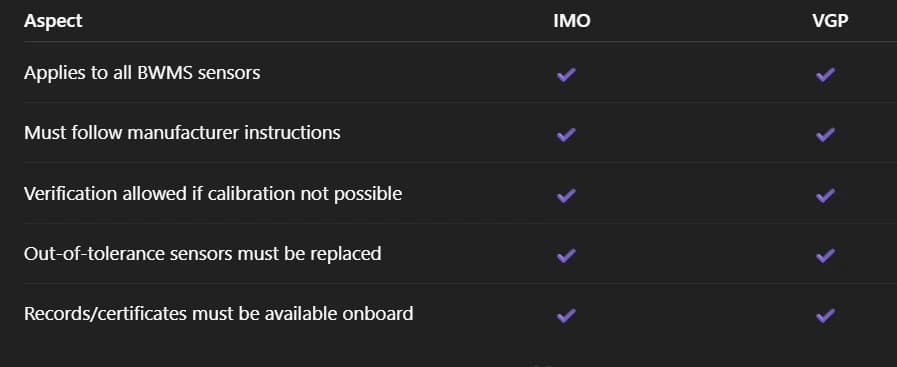
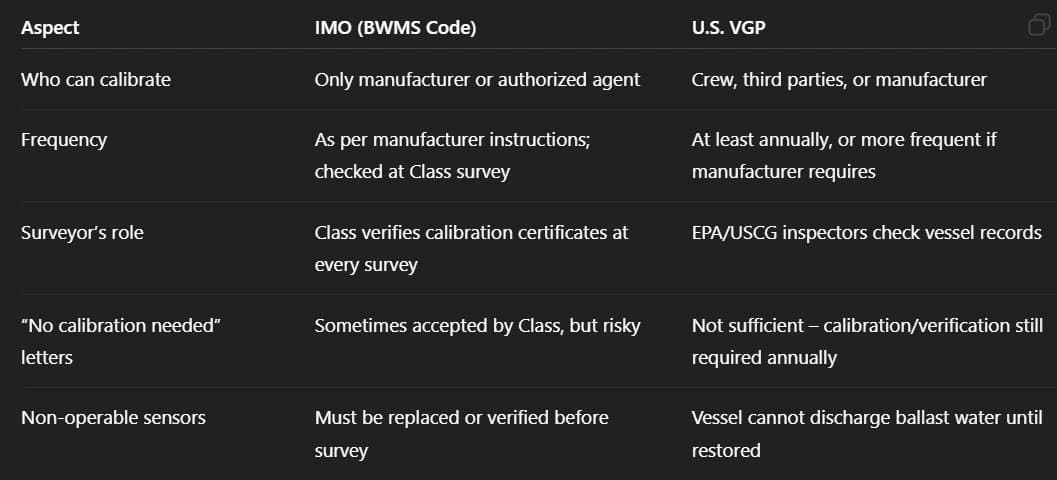
4. Key Differences
5. Port State Control (PSC) & Class Inspections
Under IMO:
- PSC officers and Class Surveyors will request calibration certificates during inspections.
- Expired or missing certificates may result in deficiencies or even detention.
- Because the BWMS Code is strict, some PSC officers may reject third-party calibration if it is not maker-authorizes
In the USA:
- The USCG enforces U.S. regulations, not the IMO Convention.
- However, during boardings they check ballast water compliance, including calibration/verification records, because the EPA’s VGP requires it.
- If calibration is overdue or undocumented, the EPA can issue fines and the USCG can restrict ballast discharge until compliance is restored.
Bottom line: PSC officers can and do check calibration certificates, even though the basis differs (Class/IMO under the Convention, EPA/USCG under U.S. law).
6. Practical Challenges & Best Practices
Shipowners often face operational constraints: short port stays, lack of calibration gases (hydrogen, nitrogen), or unavailability of manufacturer service. To avoid failed attendances and survey issues, we recommend:
- Plan ahead: Verify sensor condition before arranging attendance.
- Remote checks: Have crew perform ballast/deballast trials, send data logs, photos, and videos of TRO sensors to confirm readiness.
- Ensure supplies: Provide calibration gases (e.g. hydrogen 50% LEL, nitrogen 99.999%), TRO chemicals, and neutralizing agents.
- Schedule downtime: Allocate 6–12 hours of system downtime for calibration.
- Keep records in order: Certificates (for IMO) and annual calibration/verification logs (for VGP) must be up-to-date and easily accessible.
- Check with Class in advance: If calibration is by an independent provider, confirm if the surveyor will accept it for IMO purposes.
Conclusion
BWMS sensor calibration requirements may appear similar, but the details matter:
- IMO: Strict on who may calibrate (maker only), flexible on timing (per manufacturer), focused on certificates at Class/PSC surveys.
- VGP: Strict on timing (annual at minimum), flexible on who may calibrate, focused on records during U.S. inspections.
Understanding these differences is essential for compliance. By planning ahead, keeping calibration records in order, and choosing the right service approach, shipowners can stay clear of fines, detentions, or operational disruptions.
For sure our position is clear, always strive to bring the maker for Sensors Calibration and look for alternatives only when the maker is not available.
The views presented are only those of the author and are for information sharing and discussion purposes only.