Nearly one in five seafarers surveyed said they had faced psychological harassment, while men made up 67% of those reporting sexual harassment, according to the Diversity Study Group’s latest review of diversity, equity and inclusion in maritime workplaces.
The Diversity Study Group (DSG) published its Annual DEI in Maritime Review 2026, Holding steady in uncertain times, which looks at workplace belonging, psychological safety and inclusion across the maritime sector. The report draws on replies from 6,210 seafarers, compared with 5,976 in 2025 and 3,323 in 2024, as well as nearly 1,700 shore-based employees across 11 organizations.
Harassment remains a major concern at sea
The survey suggests that harassment continues to affect crew members across ranks and identities, with some groups facing sharper exposure than others. Nearly one in five seafarers said they had experienced psychological harassment, including bullying, and the proportions were particularly high among women, lesbian, gay and bisexual seafarers, Black seafarers and middle-ranking staff.
- 40.3% of female seafarers reported psychological harassment.
- 38% of lesbian, gay and bisexual seafarers reported psychological harassment.
- 28.2% of Black seafarers reported psychological harassment.
- 28.1% of middle-ranking seafarers reported psychological harassment.
- 18.6% of male seafarers reported psychological harassment.
Sexual harassment also remained a serious issue. Nearly one in three female seafarers surveyed said they had experienced it, yet men accounted for 67% of all respondents who reported sexual harassment. Middle-ranking workers represented 28% of those reports. DSG said the rising proportion of male seafarers reporting harassment shows prevention and reporting systems need to reflect the experience of all crew members.
Harassment is not just an issue about women on ships; it’s a question of creating working environments that are safe for everyone.
The group added that psychological safety is essential not only for inclusion but also for the safe and effective operation of vessels.
Mid-level employees report the weakest workplace experience
The report highlights what it calls the “squeezed middle,” with middle-ranking employees at sea and ashore describing less positive experiences than junior and senior colleagues. At sea, 7.1% of middle-ranking respondents said they had experienced discrimination, compared with 2.9% of cadets and 4.1% of officers. Middle-ranking seafarers also received the lowest scores when asked whether they would recommend their company as an employer.
Ashore, managers and team leaders were less likely to feel safe speaking up, while mid-level employees reported growing frustration over career stagnation, pay gaps, limited recognition and management conduct. DSG said these results underline the need to sustain engagement and offer development opportunities beyond the early years of a maritime career.
Women are more visible at entry level, but senior gaps persist
Women made up just 2.4% of the seafarer survey sample, but they represented 19.2% of cadets in 2026, up from 12.4% in 2025. DSG said this points to early progress in efforts to attract more women into seafaring. At the same time, nine out of ten female seafarers said they felt able to be themselves at work.
That improvement has not yet carried through to the upper ranks. Women remained underrepresented in senior positions at sea, and ashore they accounted for only 14.6% of respondents at head-of-department level. Their representation also fell in several male-dominated shore-side functions, including technical and fleet management, IT, operations and commercial departments.
Training and development are linked to stronger belonging
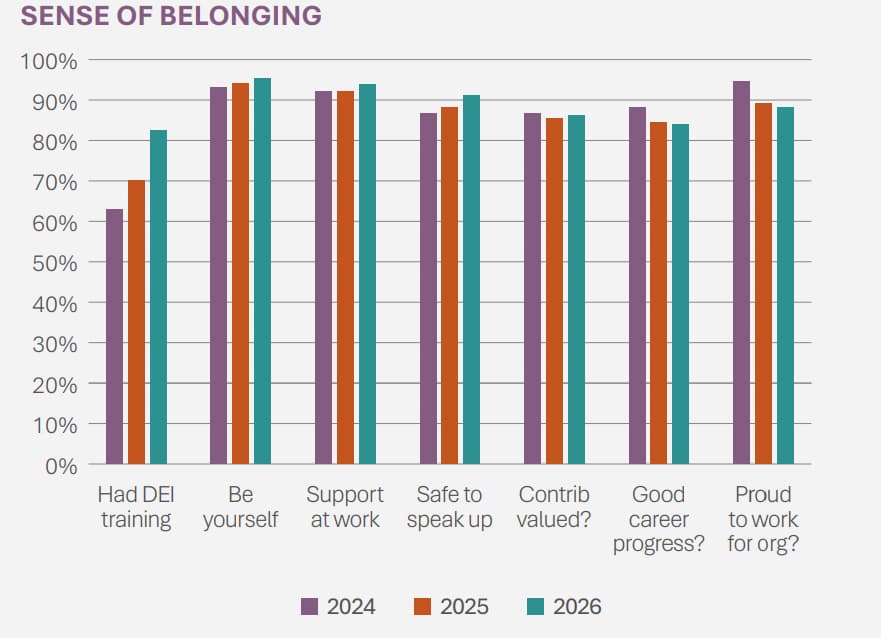
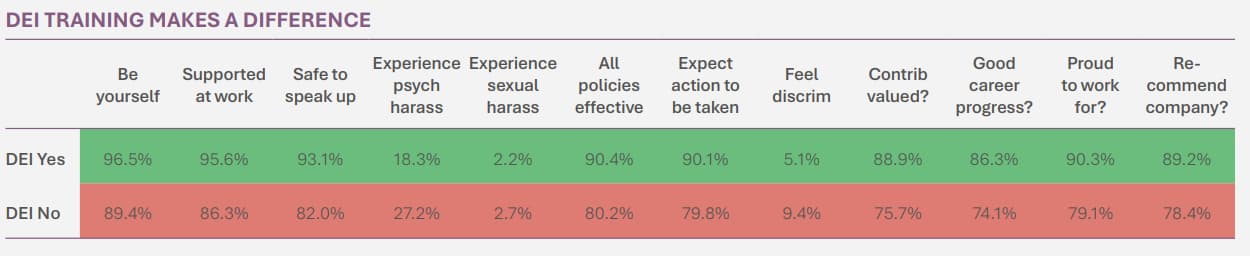
Despite the remaining problems, the report points to positive movement in DEI awareness and workplace belonging. The share of seafarers saying they had received DEI training climbed from 63% in 2024 to 82.4% in 2026. Those who had taken part in training were more likely to describe better experiences onboard and greater confidence in their employers and careers.
Overall, 88% of seafarers surveyed said they were proud to work for their company, although positive views of career progression slipped from 88% in 2024 to 83.9% in 2026. Ashore, regular personal development discussions with managers stood out as one of the strongest predictors of belonging and psychological safety.
- 87.1% of employees who had such conversations in the previous six months felt safe speaking up, versus 70.2% of those who had not.
- 89.4% felt their contribution was valued, compared with 60.7%.
- 90.6% felt supported in the workplace, compared with 68.1%.
DSG warns the policy gap is still a problem
Nationality-based inequality emerged as another major issue, with seafarers citing favoritism, exclusion and differences in pay, contracts, promotion prospects and work allocation. DSG said the problem is less about a lack of DEI policies than the gap between what organizations promise and what workers experience in practice.
To narrow that gap, the report urges shipping companies to establish multiple confidential reporting channels available to all seafarers, treat complaints seriously and ensure unacceptable behavior carries clear consequences. It also calls for masters, chief engineers and other senior officers to be equipped to support psychological safety and inclusive onboard cultures, while career-long development, greater transparency in employment practices and action on nationality-based inequality are also recommended.
People work better when they feel at home in their organisation and their team.
DSG said meaningful progress depends on leadership accountability, fair treatment and making sure employees feel safe, valued and supported throughout their careers, both at sea and ashore. The findings come as the industry pays more attention to psychological safety and mental health support onboard. The 2026 SEAFiT Crew Survey, with responses from 23,138 seafarers, found continuing gaps in mental health support despite broader improvements in crew welfare, and its 2027 edition is expected to place greater emphasis on respect, dignity and psychological safety.