Seafarer wellbeing is drawing sharper regulatory attention as mental health, fatigue and harassment are increasingly treated as maritime safety issues, according to VIKAND. In a new insight report, the company argues that the maritime sector is moving toward a model where crew health is considered alongside vessel condition and equipment reliability as part of safe operations.
VIKAND report tracks a changing regulatory approach
The report, “Seafarer Wellbeing Enters the Safety Rulebook”, was published on November 25 and written by John Prell, VIKAND’s General Counsel and former seagoing officer. It examines how regulatory expectations are evolving for shipowners and managers who are responsible for protecting crews. The underlying message is that safety thinking is broadening to include the people running ships, not just the systems they operate.
There is still no single international law that covers seafarer wellbeing in one place. Even so, changes in international conventions, flag state requirements and safety management guidance are pointing in the same direction: crew health is being acknowledged more clearly as an operational risk that can affect safe shipboard performance.
In an exclusive interview to, Ronald Spithout, Managing Director of OneHealth by VIKAND, said real care for seafarers requires companies to go beyond procedural box-ticking and adopt a wider view of human sustainability.
Persistent onboard strain remains part of the picture
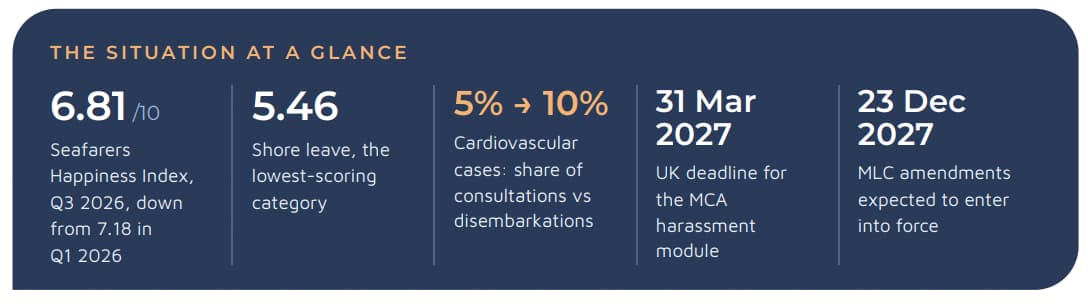
The regulatory shift is unfolding while seafarers continue to describe significant pressures in daily work. The Mission to Seafarers’ Seafarers Happiness Index showed overall happiness slipping from 7.18 out of 10 in the first quarter of 2026 to 6.81 in the third quarter, suggesting that confidence and morale remain under strain in several areas of life at sea.
Among the strongest declines, shore leave fell from 6.78 to 5.46. Workload satisfaction was largely steady, but respondents still pointed to long hours and differences between what was recorded and what was actually rested. Similar issues appeared in the 2026 SEAFiT Crew Survey, which also found that crew wellbeing gaps remain despite some improvements in other areas.
Although the Seafarers Happiness Index relies on voluntary responses, VIKAND says its findings still mirror many of the concerns regulators are now examining more closely.
Examples of how safety rules are shifting
The report points to several developments that show wellbeing being tied more directly to compliance. These changes vary in scope and legal force, but together they suggest that human factors are moving further into the regulatory mainstream.
- Violence and harassment: Since January 1, 2026, amendments to the STCW Convention have made harassment prevention and response part of mandatory basic safety training.
- Working and living conditions: Amendments to the Maritime Labour Convention (MLC), expected to enter into force on December 23, 2027, are set to strengthen protections against harassment and improve provisions on shore leave, repatriation and fair treatment.
- Safety management: The IMO is working toward revised ISM Code implementation guidelines by 2028, with attention to harassment reporting, retaliation, leadership responsibilities and psychological support.
- Fatigue: An ongoing IMO review is considering whether current work and rest rules adequately address fatigue, including how workload relates to crewing levels.
- Mental health: In May 2026, Liberia issued guidance stating that operators’ existing responsibilities under the ISM Code also cover mental health risks.
VIKAND says these measures differ in timing and legal effect, but they all reflect a stronger regulatory focus on human-related risk management.
Health issues can affect vessel operations
Beyond the legal and compliance angle, the report also stresses the operational consequences of neglecting physical health. VIKAND’s OneHealth clinical data from commercial shipping between 2024 and 2026 found that cardiovascular conditions made up approximately 5% of medical consultations, yet accounted for around 10% of crew disembarkations.
The company cautions that these figures do not by themselves prove a rise in cardiovascular emergencies. They do, however, show how serious such cases can be and how quickly they can disrupt both individual seafarers and ship operations. The report also cites Gard’s 2026 Crew Claims Report, based on approximately 3,000 crew claims from 2025, which identified cardiovascular illness as the leading cause of crew fatalities in that dataset.
For shipowners and managers, the implication is straightforward: health risks need to be identified early, before they escalate into emergencies or undermine a seafarer’s ability to work safely.
Compliance must work in practice, not just on paper
Prell’s central concern is whether company procedures actually work onboard. He notes that accurate records, written policies and access to medical care are important, but they cannot make up for too few crew, chronic overwork or a culture that discourages people from speaking up.
Regulation alone won’t solve every problem.
VIKAND says operators should test whether training, reporting routes, crewing arrangements and medical support are strong enough to identify and respond to emerging problems. In practical terms, the test will be whether seafarers feel able to report harassment, whether logged rest time reflects real rest and whether crew members can obtain appropriate support when they need it. As Prell emphasized, the challenge is to make sure compliance leads to real gains in the health, wellbeing and safety of those working at sea.