Recent maritime research and industry guidance show that bullying and sexual harassment at sea remain difficult to stop, report and investigate, even where formal procedures exist. The problem is not only whether seafarers know how to complain, but whether they can do so without risking retaliation, career damage or further exposure to the person accused. Checklist 5 of WISTA Germany’s Best Practice Guide focuses on that gap between policy and practice.
Why formal reporting can fail onboard
Seafarers may understand the reporting route and still decide against using it. Fear of being sidelined, losing reputation, damaging future prospects or having to keep working alongside the alleged perpetrator can make a complaints process feel unusable. Onboard conditions can intensify those concerns because shipboard hierarchies are pronounced, privacy is limited and people remain together at sea for long periods.
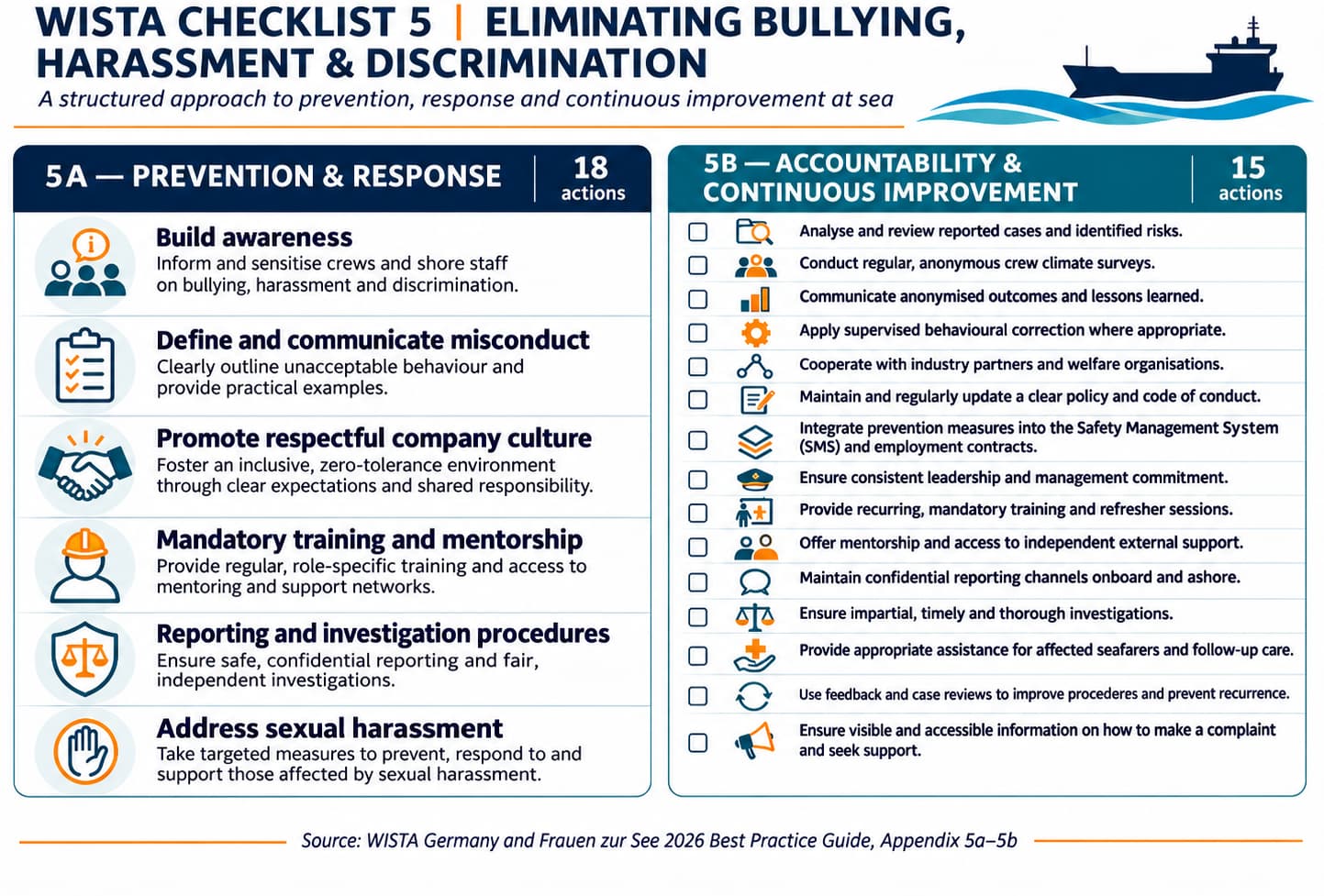
The fifth checklist in the Best Practice Guide for the Recruitment and Integration of Women on Board, developed by WISTA Germany with Frauen zur See, is aimed at two linked goals: removing bullying, harassment and discrimination, and creating accountability with continuous improvement. Building on earlier parts of the guide on leadership and working culture, it sets out the procedures and responsibilities needed to prevent misconduct, protect those affected and ensure complaints are handled properly.
New research exposes persistent gaps in protection
A November 2026 report commissioned by The Seafarers’ Charity, titled Not the woman I was before: Step up, step in by standing up to sexual assault and harassment at sea, adds fresh evidence from women working on merchant vessels. The study was written by Professor Carole Davis and Courtney Newsham and draws on anonymised accounts from 12 UK female seafarers who served on different vessel types between 2019 and 2025.
Participants described unwanted physical contact, sexual intimidation, sexist remarks and behaviour that was often treated as harmless banter. The report also found uneven responses to complaints, including cases in which employers did not investigate allegations properly or failed to impose appropriate consequences. While the research is qualitative and does not establish how common harassment is across the wider industry, it does show the impact of power imbalance and weak organisational response.
Separate evidence points in the same direction. The Diversity Study Group’s Annual DEI in Maritime Review 2026, based on responses from 6,210 seafarers, found that nearly one in five respondents had experienced psychological harassment, while nearly one in three female seafarers surveyed reported sexual harassment. Taken together, the findings indicate that harassment is not an issue limited to women alone, but one that affects crews across ranks and genders.
Why reporting remains difficult
Reporting becomes especially fraught when the alleged perpetrator is senior to the complainant. For cadets, dependence on that person may shape training assessments, completion of mandatory sea time and later job prospects. The Seafarers’ Charity research says reporting misconduct could even lead to disembarkation, disrupt training or delay professional qualifications.
Comparable barriers were identified in Safer Waves’ 2025 research. Among its self-selected respondents, 80% said they had experienced or witnessed sexual violence at sea, yet only 35% had spoken to anyone about it. Those figures are not intended to represent the whole workforce, but they do illustrate the reluctance participants felt. In an exclusive interview, Jessica Brannan, CEO of Safer Waves, said the onboard hierarchy can discourage reporting when the alleged perpetrator is also the person to whom an incident should be reported.
She also pointed to situations in which complainants were removed from vessels rather than the people accused, creating further professional consequences for those who sought help. For that reason, Checklist 5 stresses accessible and confidential reporting channels, trained contact persons and safeguards against retaliation.
Unspoken: learning from seafarers’ experiences
One attempt to bridge the gap between reported incidents and lived experience is Unspoken, launched in April 2026 by the Global Maritime Forum’s All Aboard Alliance. As outlined in The unspoken cost of sexual misconduct at sea, the project gathers anonymised accounts of unwanted sexual behaviour onboard and uses them to inform a consistent global framework for how companies identify, assess, prevent and respond to misconduct.
The initiative is supported by The Seafarers’ Charity and involves several maritime welfare organisations, with serving as a media partner. Mikael Skov, CEO of Hafnia and All Aboard Alliance Co-Chair, said confronting uncomfortable realities about life at sea is necessary if working conditions are to improve and maritime careers are to become more attractive.
What sets Unspoken apart is its focus on first-hand accounts, including experiences that never made it into company reporting systems. Those accounts are meant to reveal how incidents are classified and handled differently from one company to another. At the same time, the project is not a formal reporting platform or emergency service; its role is to support better industry procedures through anonymised experiences and shared learning.
Training crews to intervene safely
The November report from The Seafarers’ Charity also shifts part of the responsibility toward witnesses, rather than placing the burden only on the person subjected to harassment. It recommends the 5Ds model: Distract, Delegate, Document, Delay and Direct. The model gives bystanders practical options if they see inappropriate conduct.
A crew member witnessing sexist comments, for example, might interrupt the exchange, ask a trusted colleague for help, document what happened in a safe way or check on the affected person later. Direct intervention should only be used when it does not add risk. This approach sits alongside the STCW amendments that entered into force on 1 January 2026, which introduced mandatory minimum training on preventing and responding to violence and harassment, including sexual assault and bullying.
Even so, training alone cannot replace clear procedures, competent investigations and meaningful support for seafarers who experience misconduct. An October 2026 RAND study on sexual assault and harassment prevention in the US Coast Guard found fragmented responsibilities, inconsistent reporting systems, lengthy investigations and insufficient support resources. Although the Coast Guard operates in a different organisational and legal environment from commercial shipping, the study underscores the limits of judging prevention mainly by whether training has been completed.
Responding appropriately when misconduct is reported
When a seafarer does disclose harassment or sexual assault, the first response can determine whether they feel able to continue with a complaint. Jessica Brannan has stressed that those who receive disclosures need the right knowledge and skills to avoid causing additional harm.
In August 2026, the Merchant Navy Welfare Board and The TK Foundation funded Safer Waves to develop specialist training for welfare personnel across the UK. The programme covers trauma-informed communication, safeguarding, handling disclosures and guiding seafarers towards specialist assistance.
Mental Health Support Solutions (MHSS) also reported a practical example in 2025. After introducing a mentoring programme that involved approximately 100 female seafarers and 50 mentors, MHSS saw greater willingness to disclose harassment. In one case described by the organisation, a female seafarer received psychological support before reporting her harasser. The complaint led to the perpetrator’s dismissal, and continued support enabled the seafarer to remain onboard.
That example shows why trusted support and decisive action need to work together. A process that encourages disclosure but does not act on the complaint, or a process that acts without support, is unlikely to build confidence among crew members.
Accountability beyond closing a complaint
The second half of Checklist 5 turns to accountability and continuous improvement. It encourages companies to review incidents, monitor corrective action and test whether reporting procedures are working. Complaint numbers alone, however, do not tell the full story. Few reports may mean little misconduct, but they may also mean that people do not trust the system enough to use it.
For that reason, companies are advised to look beyond raw complaint totals and examine investigation times, protective measures, fear of retaliation and whether corrective steps have actually been put in place. Confidential crew feedback and anonymised case reviews can provide a clearer picture of whether the system functions as intended.
As Deborah Layde, Chief Executive of The Seafarers’ Charity, said in connection with the November report, progress must be judged by how organisations respond when people speak up, misconduct is witnessed and leadership is tested. The evidence from recent studies, industry initiatives and individual cases points to one central conclusion: the value of an anti-harassment policy depends on the response it delivers when an incident occurs.
For shipowners and managers, that means making sure seafarers can seek help without endangering their careers, that allegations are investigated fairly and that any failure exposed through complaints results in appropriate corrective action.