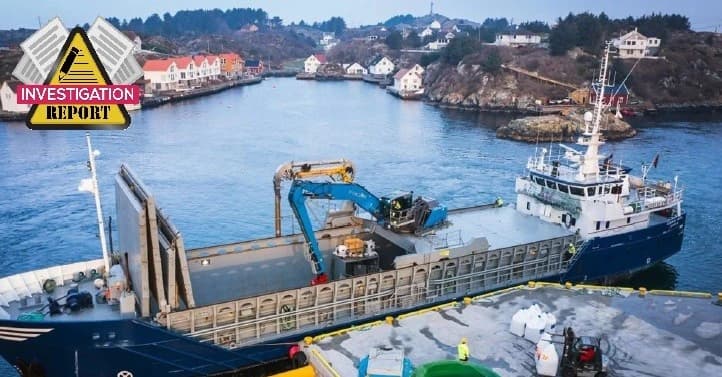
The Norwegian Safety Investigation Authority (NSIA) has published a report on a fatal occupational accident that occurred during maintenance on a material handler aboard a cargo vessel. The case involved an engine attendant who was crushed while the vessel was under way between Stavanger and Røvær, Norway, after hydraulic pressure was lost during replacement work on a valve block.
The incident on board
On October 29, 2025, the engine attendant was carrying out maintenance on the vessel’s material handler when the accident happened. The valve block that had to be replaced was located behind the operator’s cab, so the cab and its lifting frame had to be shifted forward to make enough room to work. When the hose supplying hydraulic pressure to the lifting frame was disconnected from the valve block, hydraulic oil escaped and pressure fell.
Once pressure was lost, the lifting frame started to move backward toward the hydraulic oil tank. The engine attendant was standing behind the lifting frame and could not get clear. He was trapped between the moving frame and a row of clamps at the top of the tank.
The crew quickly found him unconscious and pinned in place, but they were unable to release him. The vessel then turned around and headed to Dusavik port, where emergency services took over the rescue operation. He was freed shortly after arrival, but died from the injuries he had sustained.
What the investigation found
From the way the lifting frame behaved after the hydraulic pressure disappeared, the NSIA concluded that it had not been moved far enough forward before the work started to pass its point of equilibrium. If that point has not been passed, the frame’s own weight can make it, and therefore the cab as well, move backward when pressure is lost. The investigation did not find any technical defect in the material handler that could explain the accident.
The report says there was no physical safeguard that could stop the uncontrolled movement of the lifting frame or shield anyone working in the danger zone. Instead, safety relied on an operational measure: the cab had to be moved fully forward before the job began. Because that had not been done, no barrier remained to stop the event from turning into a fatal accident.
The material handler’s operating manual required a locking collar to prevent crushing injuries when work was carried out beneath the lifting frame. However, the locking collar was not part of the standard delivery and was not available on board.
Safety management and training gaps
The NSIA found that the risks linked to maintenance of the material handler’s hydraulic system had not been properly handled in the company’s safety management system. There was no procedure, risk assessment or job safety analysis for the task, and it was not specified that the cab needed to be moved all the way forward during maintenance behind the lifting frame.
Follow-up and internal control work were not strong enough to reveal or correct these weaknesses, and neither internal audits nor external inspections identified them. The investigation also concluded that the people involved had not fully understood the consequences of disconnecting the hydraulic hose while the cab was in that position.
Training on the material handler provided on board was limited and largely dependent on individual crew members. The NSIA said the case shows that formal qualifications and experience do not automatically provide understanding of a particular technical system and its risks. It stressed the need for equipment-specific training that covers repairs and maintenance and is based on the actual work tasks and hazards on board.
Design and access issues
The design of the material handler’s integrated platform arrangement may also have affected how the maintenance work was performed. When the cab was moved fully forward, a gap opened up between the part of the platform attached to the cab and the section fixed permanently by the tank behind it.
That gap was too wide to cross safely, and the distance down to the hatch cover was too great to allow safe access without suitable equipment. The NSIA said this may have made it seem more practical to carry out the work with the cab only partly moved forward rather than placing it fully forward.
Measures after the accident
After the accident, the company began several measures, including the following:
- acquiring locking collars for all vessels fitted with similar material handlers
- strengthening the training of machinery personnel
- improving the safety management system
The Norwegian Maritime Authority (NMA) also followed up the case with an inspection, issued an order and said it would publish a safety notice. In parallel, draft regulations on lifting appliances, loose lifting gear and lifting operations on ships have been sent out for consultation. Those proposals include more detailed training and competence requirements for material handlers on self-unloading vessels.
Lessons highlighted by NSIA
Because measures were already implemented or underway after the accident, the NSIA did not issue safety recommendations. Even so, the report set out several lessons from the case, including that safety during maintenance should not rely only on operational barriers or individual actions, and that physical barriers should be available to prevent uncontrolled movement and protect workers from crushing hazards.
The authority also said that risks connected to hydraulic systems and stored energy must be addressed properly through safety management systems, that equipment-specific training should include maintenance and repair as well as ordinary operation, and that design and access arrangements should support safe maintenance work. It added that internal audits and inspections should check whether existing safeguards match the actual working conditions on board.
DOWNLOAD THE REPORT HERE