More than $200 billion has already gone into renewable-fuel-capable vessels, but the World Shipping Council says that investment will only translate into lower emissions if fuel supply, port infrastructure and global regulation all move in step. In a new report published on 25 November 2026, the industry group argues that shipping’s transition is no longer just a matter of ordering cleaner ships; it is also a question of whether the wider market can support their use.
The report, Fuelling shipping’s energy transition as the new fleet sets sail, was released ahead of World Sustainable Transport Day on 26 November and before the International Maritime Organization’s (IMO) MEPC 85 meeting. It focuses on the growing number of container ships and vehicle carriers being built with the technical ability to run on renewable fuels, while stressing that capability alone does not guarantee uptake.
WSC says the core issue is a mismatch between vessel investment and the conditions needed to turn that investment into real emissions cuts. Fuel producers want assurance that demand will last, shipping companies need dependable and commercially workable supplies, and ports must provide the infrastructure to connect production with use. On that basis, the report presents maritime decarbonization as a system challenge rather than a fleet-replacement exercise.
Renewable-fuel-ready vessels are becoming a major part of fleet renewal
Using Clarksons data from October 2026, the report shows that renewable-fuel-capable designs are already reshaping the orderbook for liner shipping. WSC says 1,346 renewable-fuel-capable container ships and vehicle carriers are operating or on order, with 525 already in service and 821 more on order. The council argues that this scale makes alternative-fuel readiness a defining feature of new fleet investment.
The data point to a particularly strong concentration among larger vessels. Renewable-fuel-capable ships account for 34% of container ships on order, yet they represent 66% of the capacity. Their average size is approximately 15,100 TEU, compared with 4,100 TEU for other container ships on order. In practical terms, that means the transition is being driven most heavily by the biggest units being added to the fleet.
- 66% of container carrying capacity on order is renewable-fuel-capable.
- 93% of vehicle carrier capacity on order, measured in deadweight tonnage, is renewable-fuel-capable.
- 62% of combined liner shipping orderbook capacity is renewable-fuel-capable, compared with approximately 18% for the rest of the global fleet.
By around 2030, those ships could sharply raise fuel demand
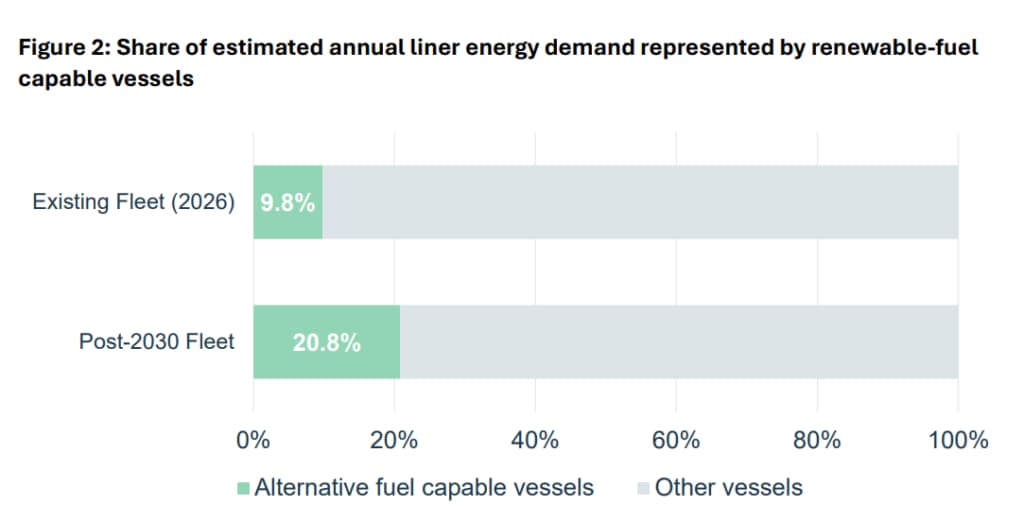
The report’s most striking projection concerns the fuel demand that could emerge once the current orderbook is delivered. WSC estimates that the vessels now on order could nearly triple the annual energy requirements of renewable-fuel-capable container ships and vehicle carriers, pushing demand from 344 PJ in the existing 2026 fleet to 980 PJ by around 2030.
In million tonnes of oil equivalent, the same projection rises from 8.2 to 23.4. As a share of liner shipping’s total energy demand, the figure increases from 9.8% to 20.8%. WSC notes that these estimates do not include any scrapping of older ships, which means the eventual market could differ if fleet turnover accelerates or slows.
The council says these numbers matter to both sides of the market. For fuel producers, they indicate a sizable customer base that is already forming. For shipowners and operators, they underline the need to secure access to renewable fuels if dual-fuel investments are to deliver the environmental outcome that justified them in the first place.
Shipping companies are investing in ships capable of using renewable fuels, and this report shows the opportunities for fuel producers around the world to supply them.
Different fuels are advancing at different speeds
WSC says the alternative-fuel landscape is far from uniform. Liquefied methane accounts for the largest share of liner shipping’s alternative-fuel vessel investments, followed by methanol, while ammonia propulsion remains at an earlier stage of adoption. The report treats these as distinct pathways with different supply chains, infrastructure needs and commercial barriers.
For renewable methane, the report points to an existing route to market because LNG-capable vessels and bunkering infrastructure can already handle bio-LNG and liquefied e-methane. Renewable methanol and ethanol, meanwhile, benefit from existing production industries and relatively straightforward storage and delivery. Renewable ammonia is still developing, but the report says its production and bunkering capabilities are emerging, even as toxicity, emissions management and dedicated safety arrangements demand particular care.
WSC also stresses that a fuel’s environmental value depends on how it is made, moved and consumed. That means investment choices cannot rest on propulsion technology alone. Lifecycle greenhouse gas emissions, sustainable feedstocks and fuel certification all need to be considered when companies decide where to place capital.
Supply chains may expand beyond established bunkering hubs
Another of the report’s central observations is that renewable fuel production does not have to stay concentrated around traditional marine fuel centers. Instead, countries with renewable electricity, agricultural resources, established fuel industries or sustainable biological materials could become important suppliers even if their domestic bunkering networks remain limited.
WSC points to several regional developments that could shape future marine fuel flows. In Africa, renewable energy resources could support hydrogen-derived fuels, while agricultural waste may provide a basis for biomethane production. In Asia and Oceania, China accounts for around 70% of announced global renewable methanol production capacity, and established hubs such as Singapore are expanding their alternative fuel capabilities.
Central and South America already show signs of commercial activity, with Brazil’s biofuel industry beginning to supply international shipping, including through bioethanol bunkering at Santos. Europe, the UK and Türkiye have the advantage of established bunkering infrastructure, renewable energy investment and regulatory incentives. North America, where the US is currently the world’s largest biomethane producer, could use its LNG infrastructure and ethanol industry to meet maritime demand.
- Africa: renewable energy resources and agricultural waste could support hydrogen-derived fuels and biomethane.
- Asia and Oceania: China’s announced renewable methanol capacity and Singapore’s expanding alternative fuel role stand out.
- Central and South America, Europe, the UK and Türkiye, and North America each have different combinations of supply potential and infrastructure.
The report says these trends point toward supply chains that connect renewable-energy-rich regions with international bunkering markets. It also notes a practical constraint across several fuel types: liquefied methane, methanol and ammonia all have lower volumetric energy density than conventional marine fuel oil, which can mean larger onboard tanks or more frequent refueling.
WSC says regulation is still the main barrier to scale
Even with vessel investment, emerging production and growing infrastructure, the council identifies the price gap between renewable and conventional marine fuels as the main obstacle to mass adoption. Shipping firms may have the ships and the technical ability to burn these fuels, but without a commercial reason to pay more, widespread use will remain limited. Fuel producers face the opposite problem: they are unlikely to expand production on a large scale without confidence that buyers will stay in the market.
Some producers are already signaling that stronger demand could lead to more supply, which WSC says shows how closely investment decisions depend on regulatory certainty. Kramek said the market will not develop on technology alone and argued that rules need to bridge the cost gap.
The fuels and technologies are already there, but creating a market at scale requires the right commercial conditions. Global regulations that close the price gap with conventional fuels are necessary to unlock investment in production and turn the potential of these ships into real emissions reductions.
The report arrives just before MEPC 85, which is scheduled for 30 November to 3 December 2026 and will include government discussions on global greenhouse gas rules for shipping. WSC wants an international framework that includes binding measures aligned with the IMO’s 2023 GHG Strategy, a credible route to net-zero emissions, strong and consistent enforcement across all ships, and commercial incentives that narrow the cost gap between conventional and zero- or near-zero-GHG fuels.
It also calls for robust lifecycle emissions assessments and fuel certification. In support of that argument, the report cites the EU Emissions Trading System and FuelEU Maritime as examples of how regulation can help create incentives for lower-emission fuel use.
Fleet capability, fuel supply and commercial viability must advance together
WSC’s broader message is that the shipping energy transition now depends on three linked elements moving together: ship capability, fuel availability and commercial viability. Fleet capability is improving through newbuilding investment. Fuel supply is developing, but unevenly, across regions and fuel pathways. Commercial viability remains tied to policy design, fuel pricing and the ability to secure long-term supply arrangements.
That makes the challenge as organizational as it is technological. The report says progress will depend on closer coordination among shipowners, charterers, ports, energy producers and policymakers so that the current wave of investment results in actual emissions reductions rather than just technical readiness.
For maritime organizations, the implications stretch beyond selecting a propulsion system. WSC highlights the need to match vessel design with realistic expectations about future fuel availability and cost, assess long-term supply contracts and supplier reliability, plan for bunkering availability and changing voyage requirements, prepare safety procedures and crew training, and monitor both global and regional compliance obligations. It also says financial planning must account for renewable fuel premiums and regulatory uncertainty, while strategic partnerships with ports, fuel producers and other supply chain participants will become increasingly important.
In the council’s view, decarbonization can no longer sit in a narrow technical lane. It has to be built into procurement, operations, finance and risk management if the industry is to convert a large renewable-fuel-ready fleet into measurable progress on emissions.